Additional LP Applications
MGMT 306
Purdue University
FloatAway Tours
Product Mix LP example
Problem Description
- Boat rental service has $420,000 for new boats
- Two different manufacturers: Sleekboat and Racer
- The new fleet must satisfy:
- At least 50 boats total
- Same number of boats from each manufacturer (goodwill)
- Total seating capacity at least 200
- Formulate an LP model to maximize total expected daily profit
| Boat | Manufacturer | Cost | Seats | E. Daily Profit |
|---|---|---|---|---|
| Speedhawk | Sleekboat | $6,000 | 3 | $70 |
| Silverbird | Sleekboat | $7,000 | 5 | $80 |
| Catman | Racer | $5,000 | 2 | $50 |
| Classy | Racer | $9,000 | 6 | $110 |
Instructions
- As a class
- Write an LP model for this problem
- In pairs
- Solve the LP model in Excel
- Output a Sensitivity Report and an Answer Report
- Check your Excel output matches the following slides
LP Model Decision Variables and Objective
Decision variables
\[\begin{aligned} &x_1&&\text{number of Speedhawks to purchase}\\ &x_2&&\text{number of Silverbirds to purchase}\\ &x_3&&\text{number of Catmans to purchase}\\ &x_4&&\text{number of Classies to purchase} \end{aligned}\]
Objective
\[\max\; 70x_1 + 80x_2 + 50x_3 + 110x_4 \quad \text{(expected daily profit)}\]
LP Model Constraints
Constraints
\[\begin{aligned} &6000x_1 + 7000x_2 + 5000x_3 + 9000x_4 \le 420000 &&\text{(budget)}\\ &x_1 + x_2 + x_3 + x_4 \ge 50 &&\text{(at least 50 boats)}\\ &x_1 + x_2 - x_3 - x_4 = 0 &&\text{(goodwill)}\\ &3x_1 + 5x_2 + 2x_3 + 6x_4 \ge 200 &&\text{(seat capacity)}\\ &x_i \ge 0 \qquad\text{for all }i=1,2,3,4 && \text{(nonnegativity)} \end{aligned}\]
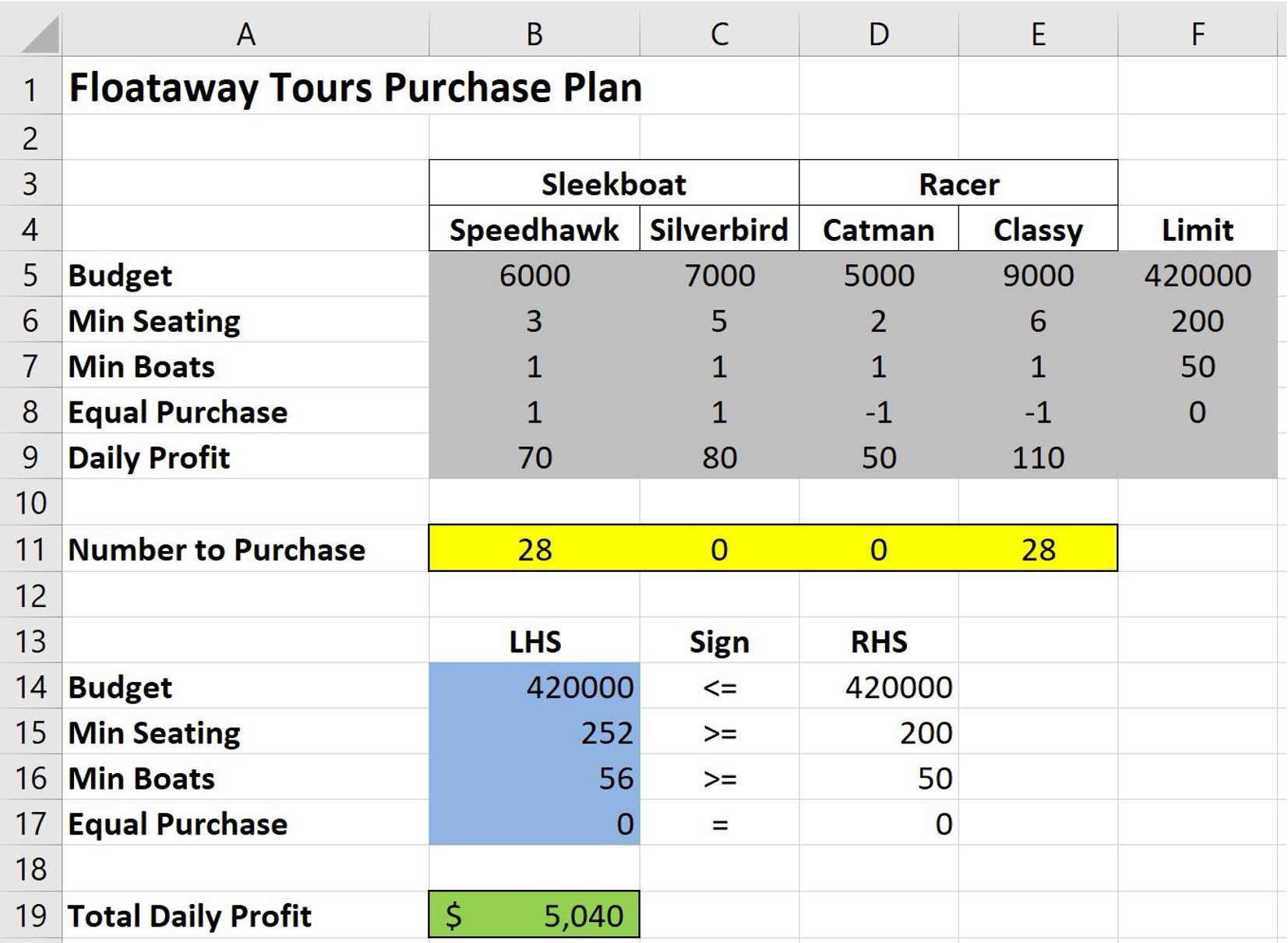
Excel Model
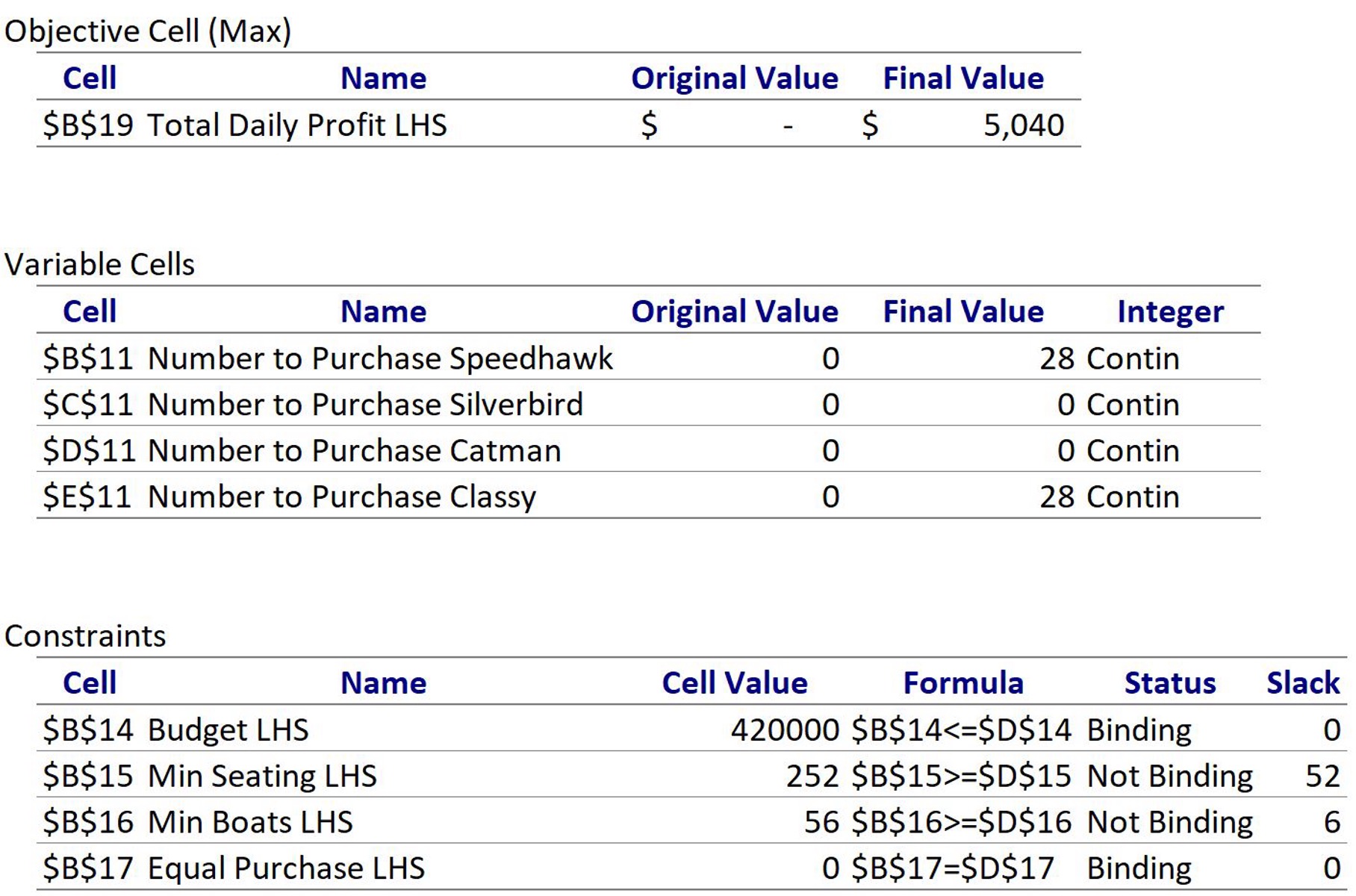
Answer Report
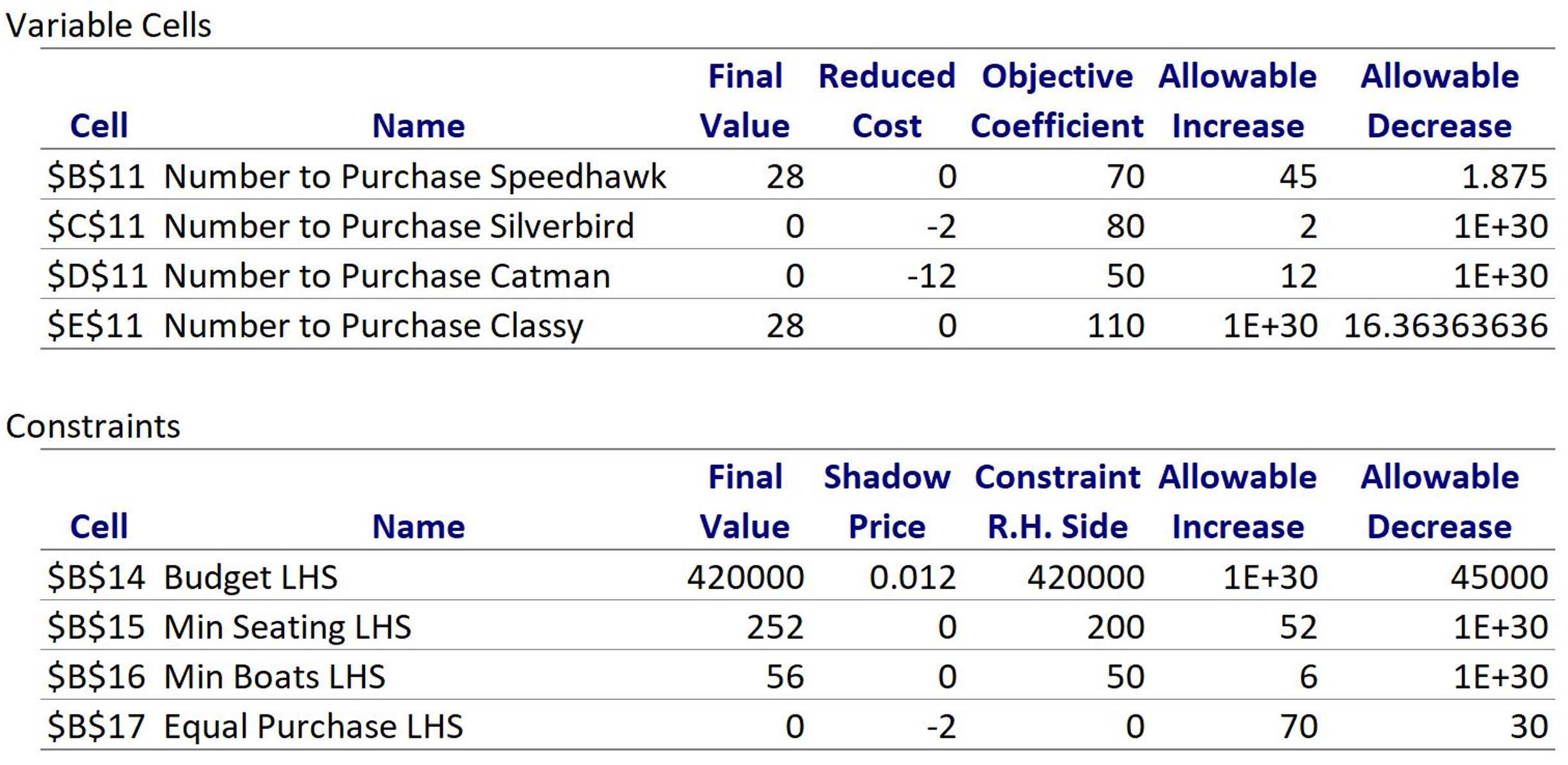
Sensitivity Report
Sensitivity Analysis Problem 1
Question. How much does the unit expected profit per Silverbird need to increase before you can justify buying Silverbirds?
Solution.
- The reduced cost of Silverbirds is -2.
- Interpretation: each Silverbird purchased would currently decrease expected daily profit by $2.
- So the expected daily profit for Silverbirds must increase by $2 to break even and justify purchasing them
Sensitivity Analysis Problem 2
Question. How much would the total expected daily profit increase if the budget is increased by \(20{,}000\)?
Solution.
- Budget RoF: \([375{,}000,\infty)\).
- New budget: \(420{,}000 + 20{,}000 = 440{,}000\) (within the RoF).
- Shadow price of budget constraint: 0.012
\[\text{change in total expected profit} = 20{,}000\times 0.012 = 240\]
CustomBikes Planning
Multi-Period Production example
Problem Description
- CustomBikes produces men’s and women’s bikes and need a production/inventory schedule for the next two months:
- how many of each model to produce in each month, and
- how many of each model to hold in inventory at the end of each month.
| Model | Production Cost | Labor Required | Current Inventory | Demand Month 1 | Demand Month 2 |
|---|---|---|---|---|---|
| Men’s | $120 | 4 | 20 | 150 | 200 |
| Women’s | $90 | 2 | 30 | 125 | 150 |
Problem Description Continued
- Additional details:
- Policy: total labor hours cannot increase or decrease by more than 100 hours from month to month
- Last month: 1,000 total labor hours
- Inventory holding cost: 2% of production cost
- At end of month 2, should have at least 25 units of each model in inventory
Write an LP Model to minimize total production + inventory holding cost.
Format of multi-period production planning LPs
- This is an instance of multi-period production planning
- To set up an LP model, for each item and each time period define:
- a production variable, and
- an ending inventory variable.
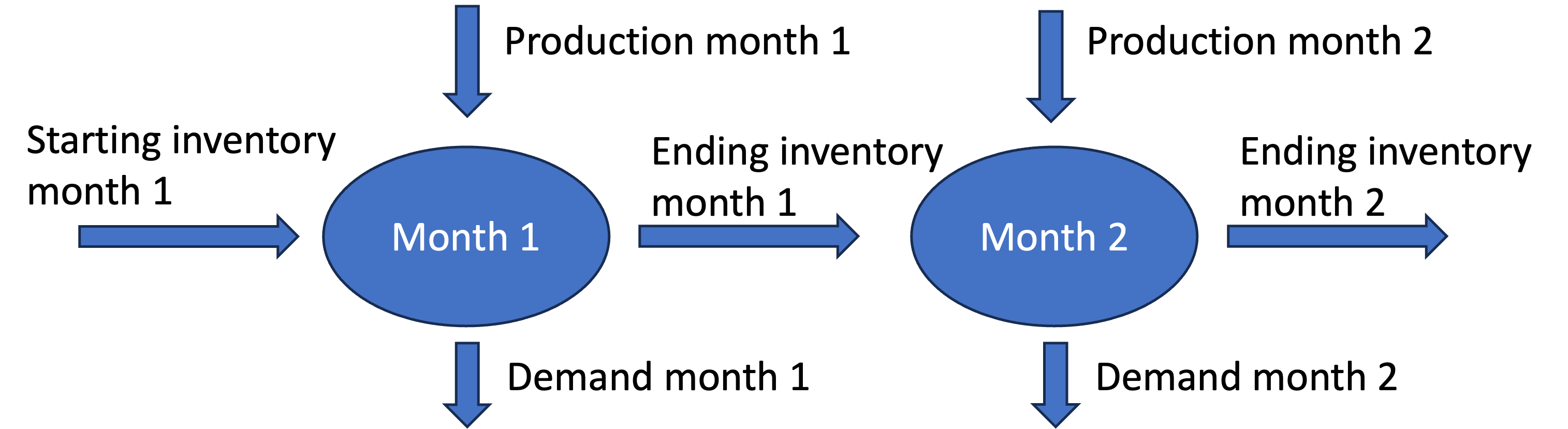
- Write balance constraints (for each item, each time period): \[\text{Starting inv} + \text{Production} - \text{Demand} = \text{Ending inv}\]
LP Model Decision Variables and Objective
Decision variables
\[\begin{aligned} &M_i&&\text{m's bikes produced in month $i$ for } i=1,2\\ &W_i&&\text{w's bikes produced in month $i$ for } i=1,2\\ &IM_i&&\text{m's bikes in inv. at end of month $i$ for } i=1,2\\ &IW_i&&\text{w’s bikes in inv. at end of month $i$ for } i=1,2 \end{aligned}\]
Objective
\[\begin{aligned} \min\quad &120(M_1+M_2) + 90(W_1+W_2)\\ +&2.4(IM_1+IM_2) + 1.8(IW_1+IW_2) \qquad\text{(Total cost)} \end{aligned}\]
LP Model Constraints
Total labor hours cannot increase or decrease by more than 100 hours from month to month
\[\begin{aligned} &4M_1 + 2W_1 \le 1100\\ &4M_1 + 2W_1 \ge 900\\ &-4M_1 - 2W_1 + 4M_2 + 2W_2 \le 100\\ &-4M_1 - 2W_1 + 4M_2 + 2W_2 \ge -100 \end{aligned}\]
At end of month 2, should have at least 25 units of each model in inventory
\[\begin{aligned} &IM_2 \ge 25\\ &IW_2 \ge 25 \end{aligned}\]
LP Model Constraints - Men’s Bikes Balance Constraints
Balance constraints for men’s bikes
\[\begin{aligned} &20 + M_1 = IM_1 + 150 &&\text{(m's month 1 balance)}\\ &IM_1 + M_2 = IM_2 + 200 &&\text{(m's month 2 balance)} \end{aligned}\]
Note Not yet in standard form
LP Model Constraints - Women’s Bikes Balance Constraints
Balance constraints for women’s bikes
\[\begin{aligned} &30 + W_1 = IW_1 + 125 &&\text{(w's month 1 balance)}\\ &IW_1 + W_2 = IW_2 + 150 &&\text{(w's month 2 balance)} \end{aligned}\]
Note Not yet in standard form
Instructions
- In pairs
- Solve the LP model in Excel
- Output a Sensitivity Report and an Answer Report
- Check your Excel output matches the Excel handout
Sensitivity Analysis Practice Question 1
Question. A bicycle retailer inquires about placing an order for 110 men’s bicycles in month 1 for $12,000. Should we sign a contract?
Solution
- Increasing men’s month-1 demand by 110 increases the RHS of the men’s month-1 balance constraint by 110
- This is outside RoF so shadow price formula is overly optimistic
- Since this is a minimization problem, \[\text{change in optimal cost} \geq 110\times 119.4 = 13{,}134\]
- We should not sign the contract.
Sensitivity Analysis Practice Question 2
Question. If the required inventory of women’s bicycles at the end of month 2 is 15 instead of 25, how much do we save?
Solution
- This change is within the allowable decrease for the Women’s Ending Inventory constraint.
- Cost change: \((-10)\times 91.2 = -912\).
- Total costs decrease by \(912\).
Sensitivity Analysis Practice Question 3
Question. The current inventory (end of month 0) of men’s bikes increases by 10. What is the new optimal cost and how many women’s bikes are held in inventory at the end of month 1 in the new solution?
Solution
- Increasing the current inventory of men’s bikes by 10 will decrease the right hand side of m’s month 1 balance constraint
- A decrease of 10 is within the range of feasibility, so \[\text{change in optimal cost} = (-10)\times (119.4) = -1194\]
- Since this change is within the range of feasibility, the binding constraints do not change: \(IW_1=0\)
Carter Inc. Problem
Multi-Period Production Planning example
Problem Description
From Textbook (Ch. 4, Problem 13)
- Carter Inc. is launching an energy bar in two flavors
- Demand for the next 3 months is given
- Resource requirements (peanuts, baking time) and costs are given
- Ending inventory at end of Month 3 should equal the initial inventory in Month 1
Task: formulate an LP to minimize total cost, build a spreadsheet model, and use Solver to find the optimal production and inventory schedule.
Multi-period production planning example
Demand (bars)
| Month 1 | Month 2 | Month 3 | |
|---|---|---|---|
| Peanut Power | 30000 | 50000 | 40000 |
| Peanut Crunch | 80000 | 100000 | 70000 |
Requirements, costs, and initial inventory
| Peanuts (grams/bar) | Baking time (hours/bar) | Prod. Cost ($/bar) | Holding Cost ($/bar) | Initial Inventory (bars) | |
|---|---|---|---|---|---|
| Peanut Power | 60 | 0.01 | 2 | 0.10 | 10000 |
| Peanut Crunch | 40 | 0.015 | 2.5 | 0.15 | 20000 |
Cash Flow Planning
Problem Description
Riverbend Capital Partners (RCP) is planning its investments for the next three years
Currently, RCP has $2.5M available for investment
RCP expects the following income stream from previous investments 1, 2, and 3 years from now:
End of Year 1 2 3 Income ($M) $0.9 $0.75 $0.6 There are three projects that RCP may participate in (fully or fractionally). Each project has projected cash flows for full participation.
End of Year 0 1 2 3 Project A Cash Flow -3.6 -0.9 0.7 6.0 Project B Cash Flow -1.6 0.4 0.5 2.1 Project C Cash Flow -2.7 -1.5 1.1 6.7
Problem Description (continued)
- RCP can borrow money at 8% interest per year, but cannot borrow more than $2M at any point in time
- RCP can also invest surplus funds at 5% per year
- Use an LP model to maximize ending wealth at the end of three years
Variables
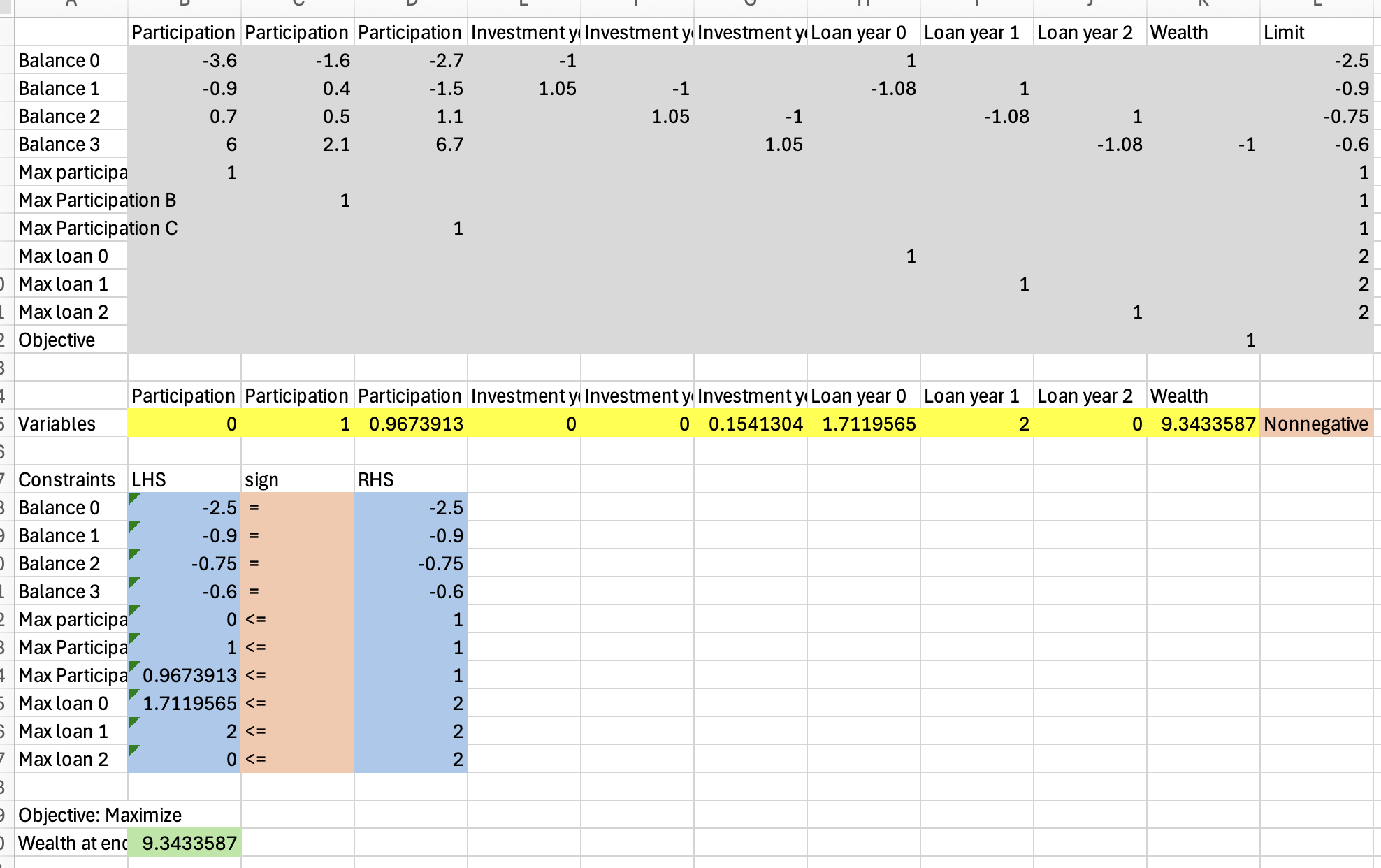
\[\begin{aligned} &x_A&&\text{participation in Project A}\\ &x_B&&\text{participation in Project B}\\ &x_C&&\text{participation in Project C}\\ &y_0&&\text{amount invested at end of year 0}\\ &y_1&&\text{amount invested at end of year 1}\\ &y_2&&\text{amount invested at end of year 2}\\ &z_0&&\text{amoung borrowed at end of year 0}\\ &z_1&&\text{amoung borrowed at end of year 1}\\ &z_2&&\text{amoung borrowed at end of year 2}\\ &w && \text{wealth at end of year 3} \end{aligned}\]
LP Model
- Objective: \[\max\qquad w \qquad\text{(wealth at end of year 3)}\]
- Constraints: \[\begin{aligned}
&x_A \leq 1 &\text{(participation in Project A)}\\
&x_B \leq 1 &\text{(participation in Project B)}\\
&x_C \leq 1 &\text{(participation in Project C)}\\
&z_0 \leq 2 &\text{(maximum loan amount year 0)}\\
&z_1 \leq 2 &\text{(maximum loan amount year 1)}\\
&z_2 \leq 2 &\text{(maximum loan amount year 2)}\\
&\text{all variables }\geq 0
\end{aligned}\]
- Still missing balance constraints
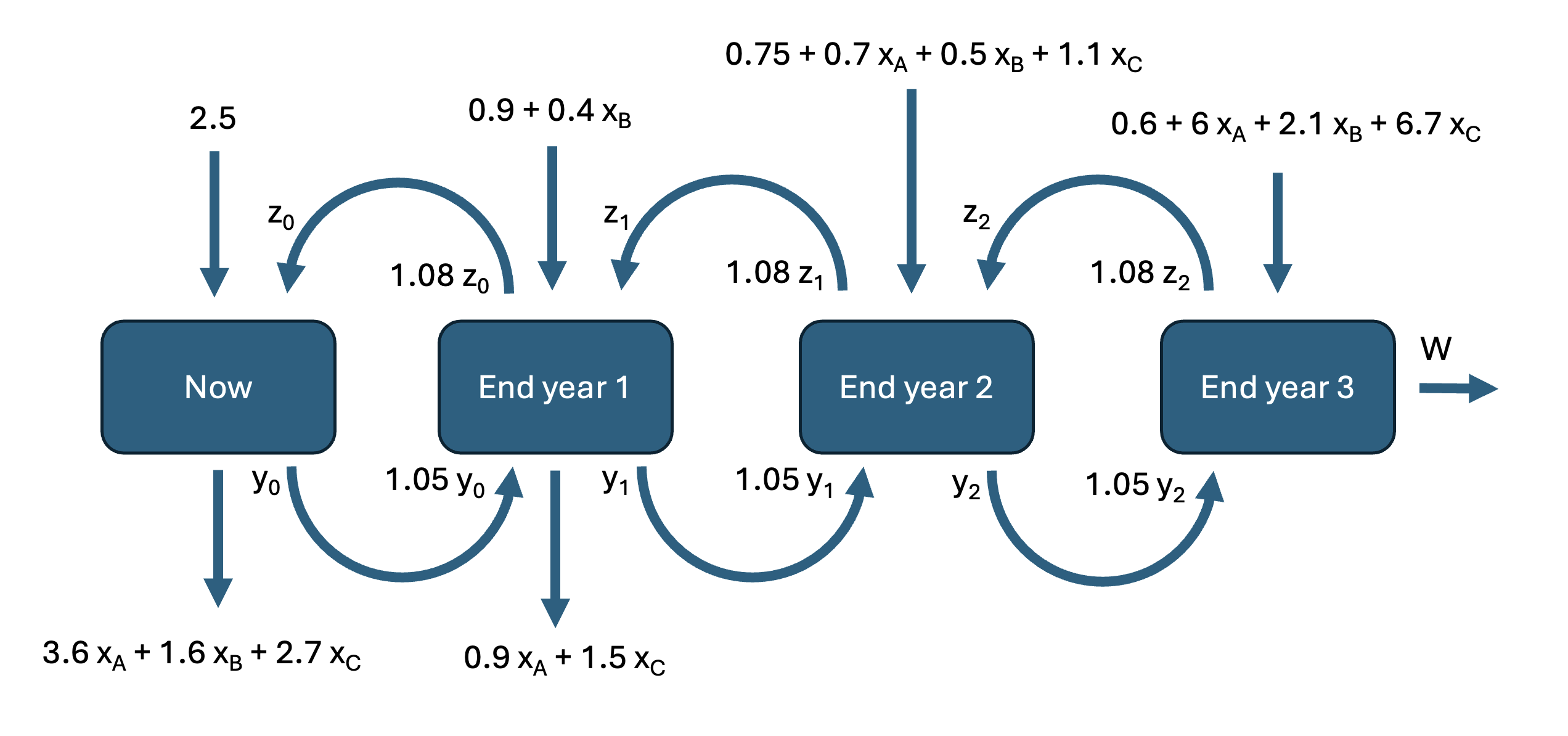
Cash Flow Picture
LP Model Balance Constraints
\[\begin{aligned} &2.5 + z_0 = 3.6x_A + 1.6 x_B + 2.7 x_C + y_0 &\text{(Balance 0)}\\ &0.9+0.4x_B +1.05y_0+z_1 = 0.9x_A + 1.5 x_C + y_1 + 1.08z_0&\text{(Balance 1)}\\ &0.75 + 0.7x_A + 0.5 x_B + 1.1 x_C+ 1.05 y_1 + z_2 = y_2+1.08z_1&\text{(Balance 2)}\\ &0.6 + 6 x_A + 2.1 x_B + 6.7 x_C + 1.05 y_2 = 1.08 z_2 + w &\text{(Balance 3)} \end{aligned}\]
Note: Not yet in standard form.
Completed Excel Spreadsheet