Integer programming
MGMT 306
What does an integer program look like?
\[ \begin{aligned} \max\quad& 3x_{1} + 2x_{2}\\ \text{s.t.}\quad& 3x_{1} + x_{2} \leq 9\\ & x_{1} + 3x_{2} \leq 7\\ & -x_{1} + x_{2} \leq 1\\ & x_{1}, x_{2} \geq 0 \text{ and integer}\\ \end{aligned} \]
- Things to notice:
- Objective function is linear in variables
- Some constraints of the form \(x_i\) integer or \(x_i\) binary
- All other constraints are linear
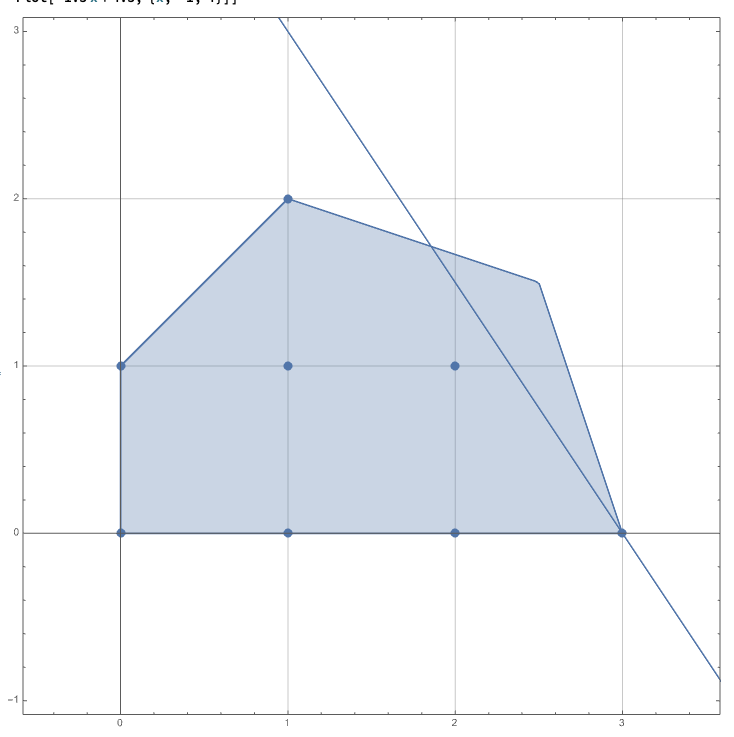
IPs have LP relaxations
- Given an IP, we can relax (drop) the IP constraints to get an LP \[ \begin{aligned} \max\quad& 3x_{1} + 2x_{2}\\ \text{s.t.}\quad& 3x_{1} + x_{2} \leq 9\\ & x_{1} + 3x_{2} \leq 7\\ & -x_{1} + x_{2} \leq 1\\ & x_{1}, x_{2} \geq 0 \text{ and integer} \end{aligned} \]
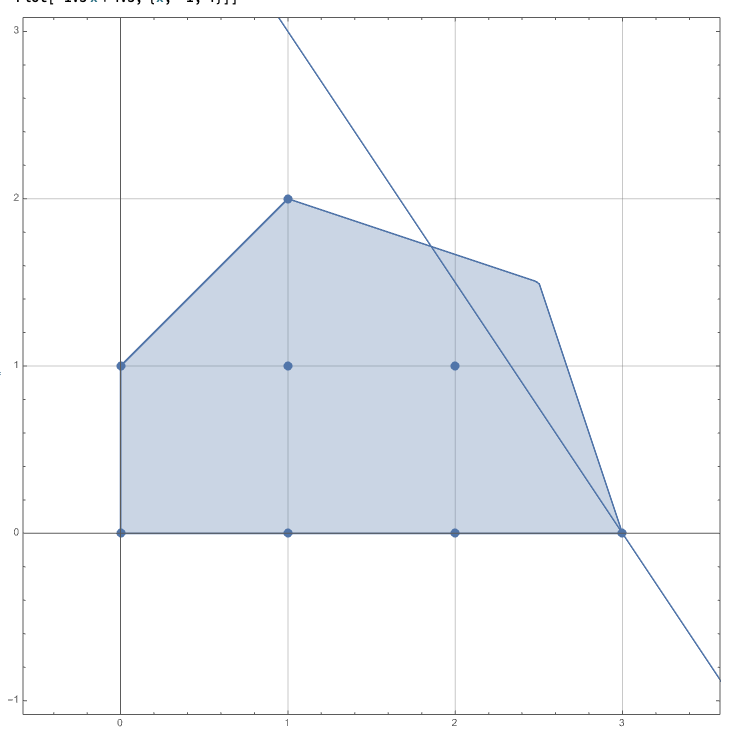
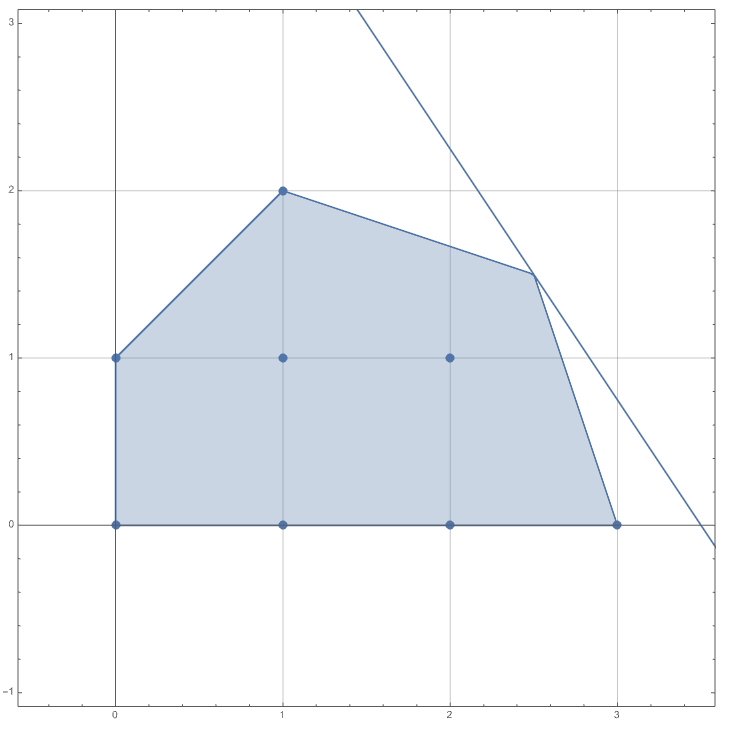
IPs have LP relaxations
\[ \begin{aligned} \max\quad& 3x_{1} + 2x_{2}\\ \text{s.t.}\quad& 3x_{1} + x_{2} \leq 9\\ & x_{1} + 3x_{2} \leq 7\\ & -x_{1} + x_{2} \leq 1\\ & x_{1}, x_{2} \geq 0 \end{aligned} \]
- The optimal value of the LP relaxation will be better than the optimal value of the IP (larger for maximize, smaller for minimize)
- Rounding the LP optimal solution is not guaranteed to find the ILP optimal solution
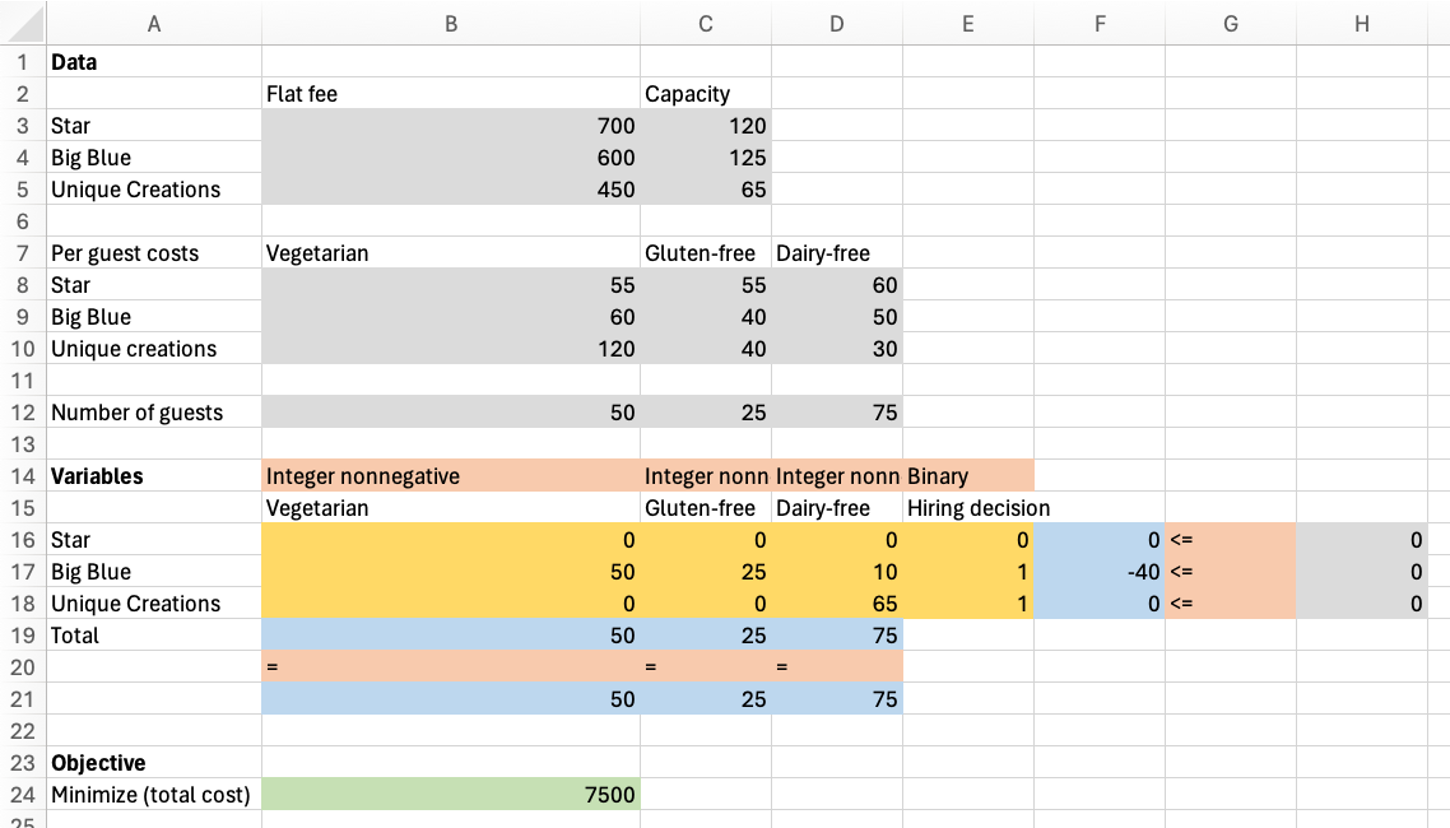
Spreadsheet Model
- We will set up the Excel spreadsheet just like for a linear program
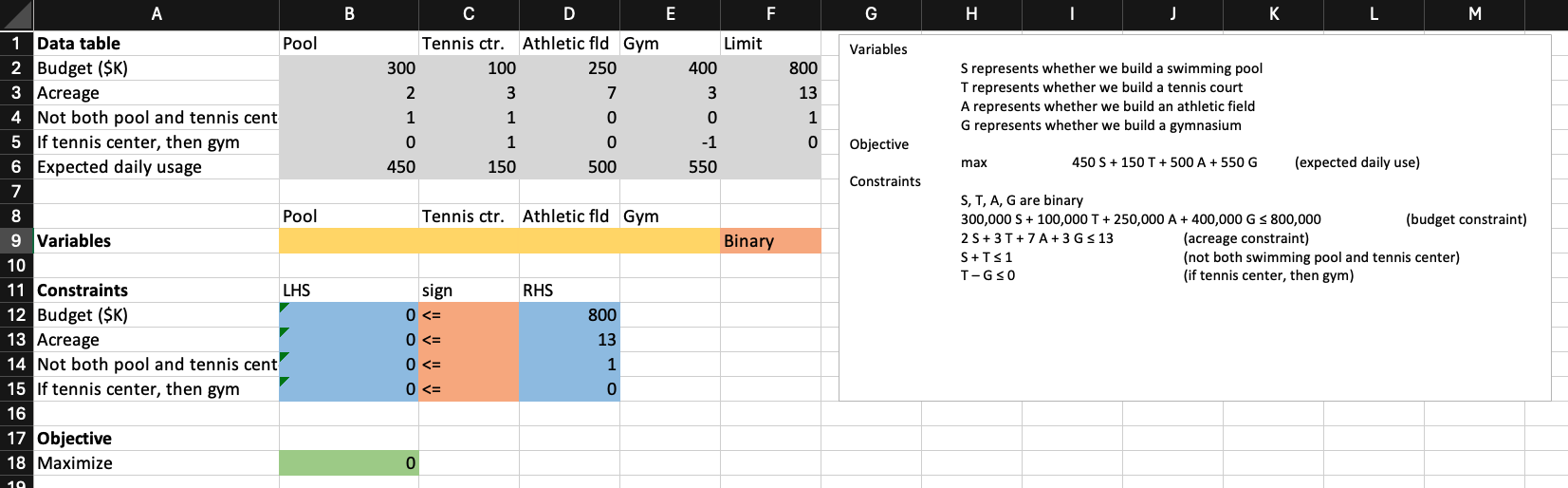
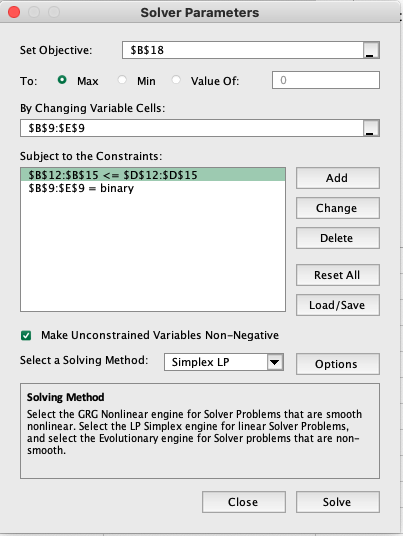
How to set up Solver for Integer Programs
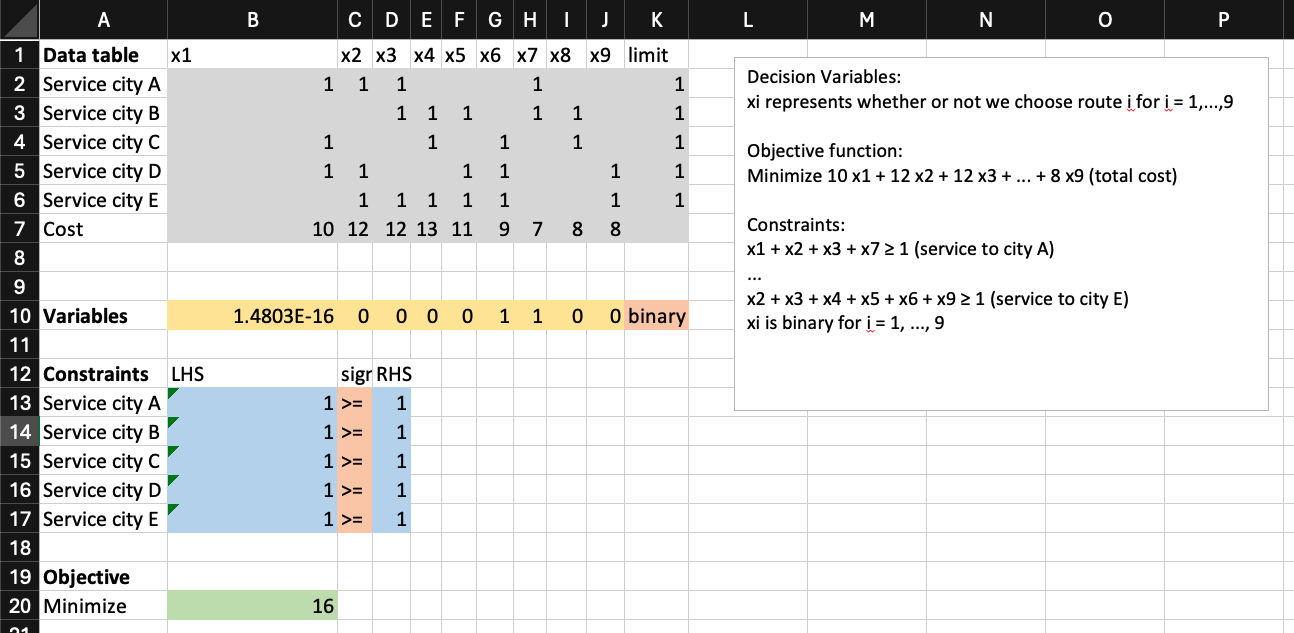
- Similar to setting up Solver for LP except that you need to add integrality restrictions (“int” or “bin”) on integer variables as shown in the Solver Parameters Box.
- We will use “Simplex LP” with additional options (next slide)
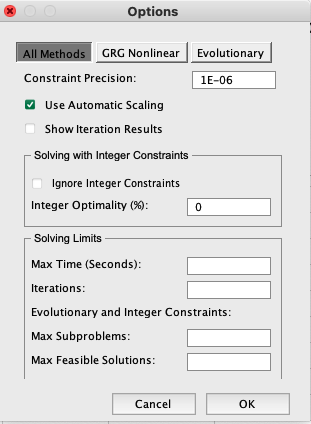
Solver Options for Integer Programs
- In the Solver Options dialogue box, set the Integer Optimality % to 0 as shown to the right.
- With very large IP, this could cause a very long run time to find the optimal solution.
- With the small IP, this will ensure that we get the optimal solution.
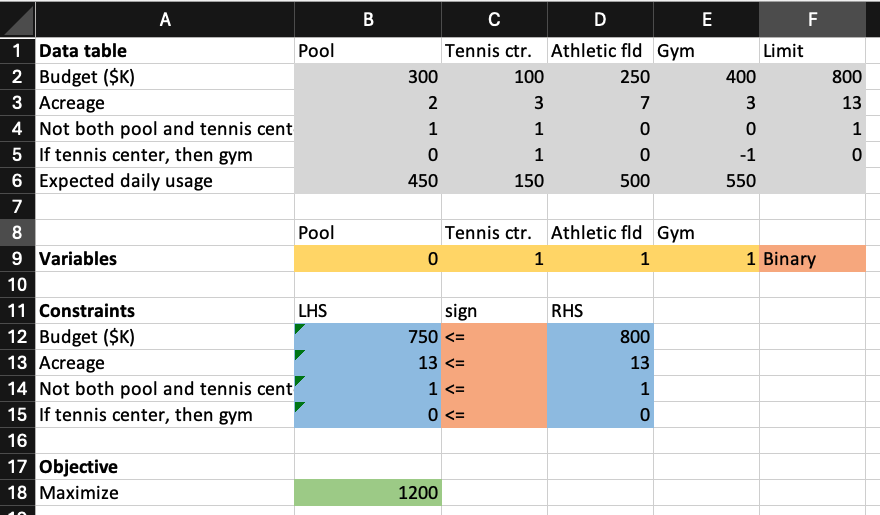
Excel usage
- The optimal solution:
Modeling A and B
We must advertise on Amazon and Bing
Truth table
| A | B | A and B |
|---|---|---|
| 0 | 0 | False |
| 0 | 1 | False |
| 1 | 0 | False |
| 1 | 1 | True |
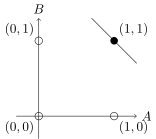
Can be modeled as \(\qquad A + B = 2 \qquad\text{or}\qquad A=1,\, B=1\)
Modeling A or B
We must advertise on Amazon or Bing
Truth table
| A | B | A or B |
|---|---|---|
| 0 | 0 | False |
| 0 | 1 | True |
| 1 | 0 | True |
| 1 | 1 | True |
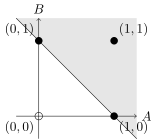
Can be modeled as \(\qquad A + B \geq 1\)
Modeling A xor B
We must advertise on either Amazon or Bing exlusively
Truth table
| A | B | A xor B |
|---|---|---|
| 0 | 0 | False |
| 0 | 1 | True |
| 1 | 0 | True |
| 1 | 1 | False |
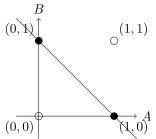
Can be modeled as \(\qquad A + B = 1\)
Modeling If A, then B
If we advertise on Amazon, then we must advertise on Bing
Truth table
| A | B | If A, then B |
|---|---|---|
| 0 | 0 | True |
| 0 | 1 | True |
| 1 | 0 | False |
| 1 | 1 | True |
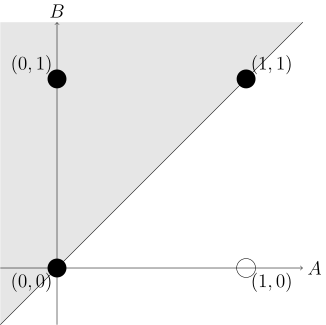
Can be modeled as \(\qquad A \leq B\)
TruckCo spreadsheet
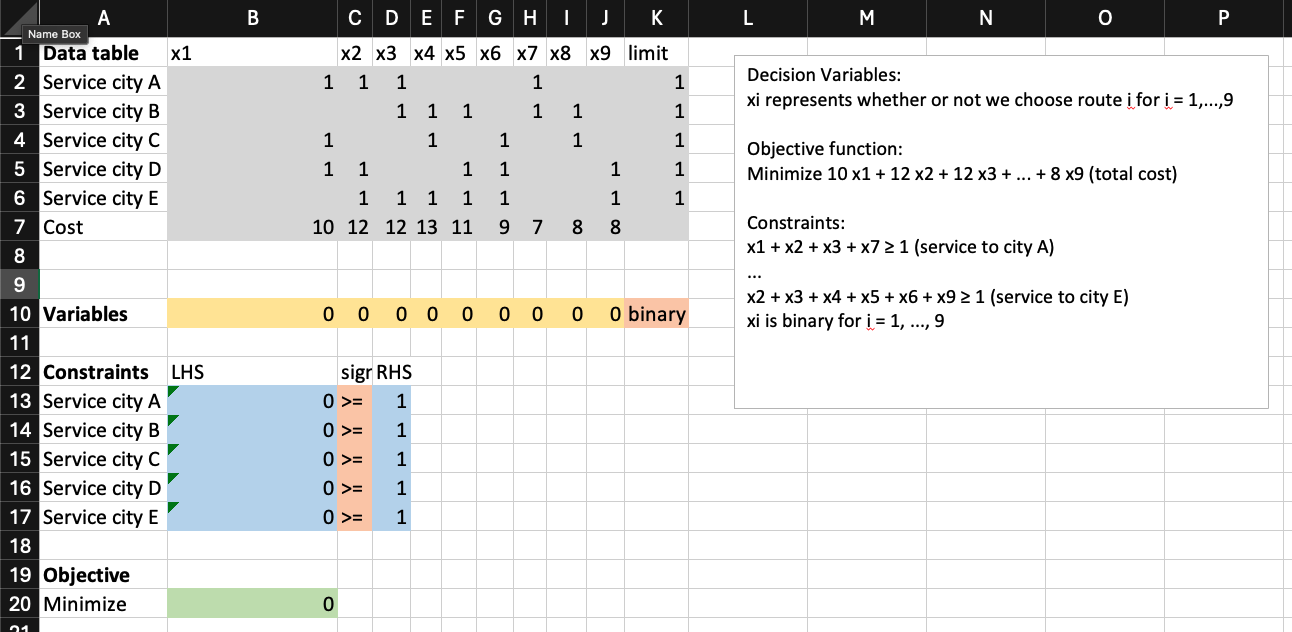
TruckCo spreadsheet
- Don’t forget to set the binary constraints and to turn the integer optimality to 0%
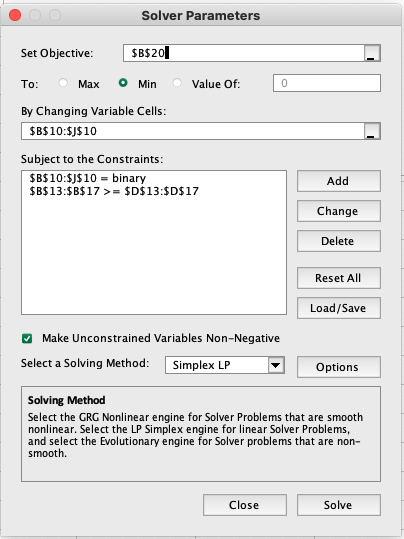
TruckCo spreadsheet with solution
Linking constraints / Big-M constraint
If we do not rent dress machinery, then we may not produce dresses
\[\begin{aligned} &D\geq 0 \text{ and integer}\\ &R_D \text{ binary} \end{aligned} \]
Suppose \(M\) is a big number and consider the constraints
Add \(D\leq M \cdot R_D\)
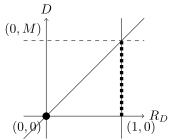
This works if \(M\) is large enough so we don’t cut off optimal solution
“What is the maximum number of dresses we can produce?”
Logical constraint 1
If shorts machinery, then at least 40 shorts should be produced per week
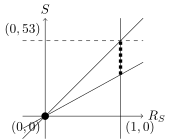
\[\begin{aligned} &S\leq 53 R_S\\ &S\geq 0 \text{ and integer}\\ &R_S \text{ binary} \end{aligned} \]
Add: \[S \geq 40 R_S\]
Logical constraint 2
If pants machinery is rented, then at most 30 dresses should be produced per week.
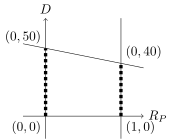
\[\begin{aligned} &D\geq 0 \text{ and integer}\\ &R_P \text{ binary} \end{aligned} \]
Add: \[D \leq 40 - 10R_P\]
This works since we know that \(D\leq 50\) at an optimal solution
Spreadsheet model
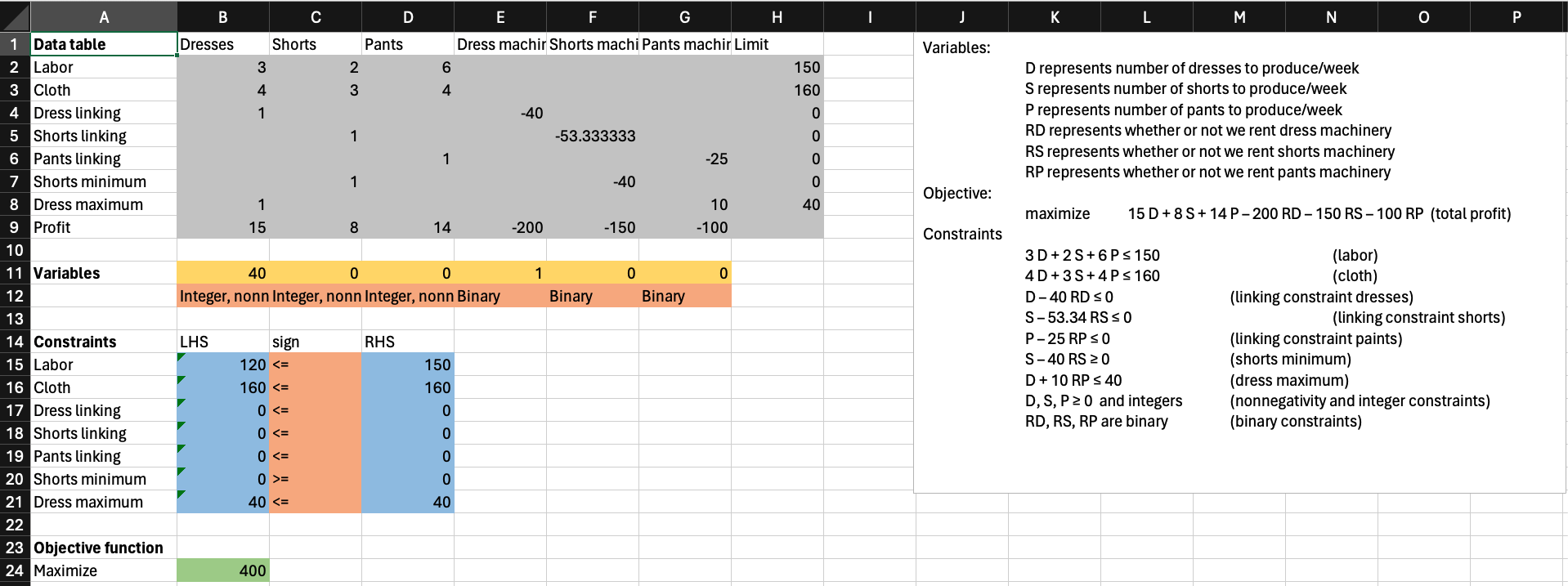
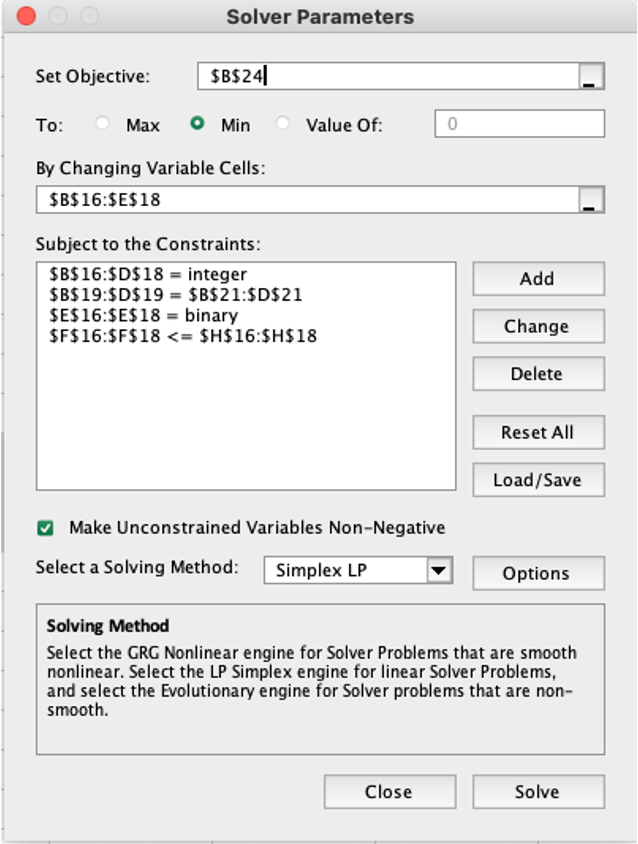
Solver settings
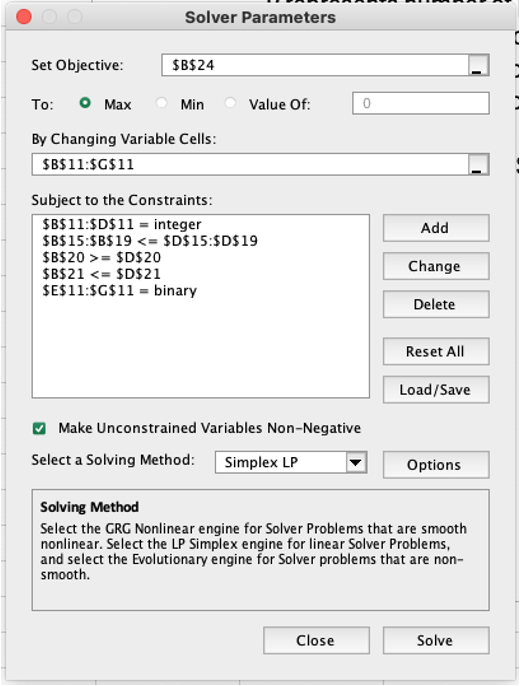
Solved Excel Model
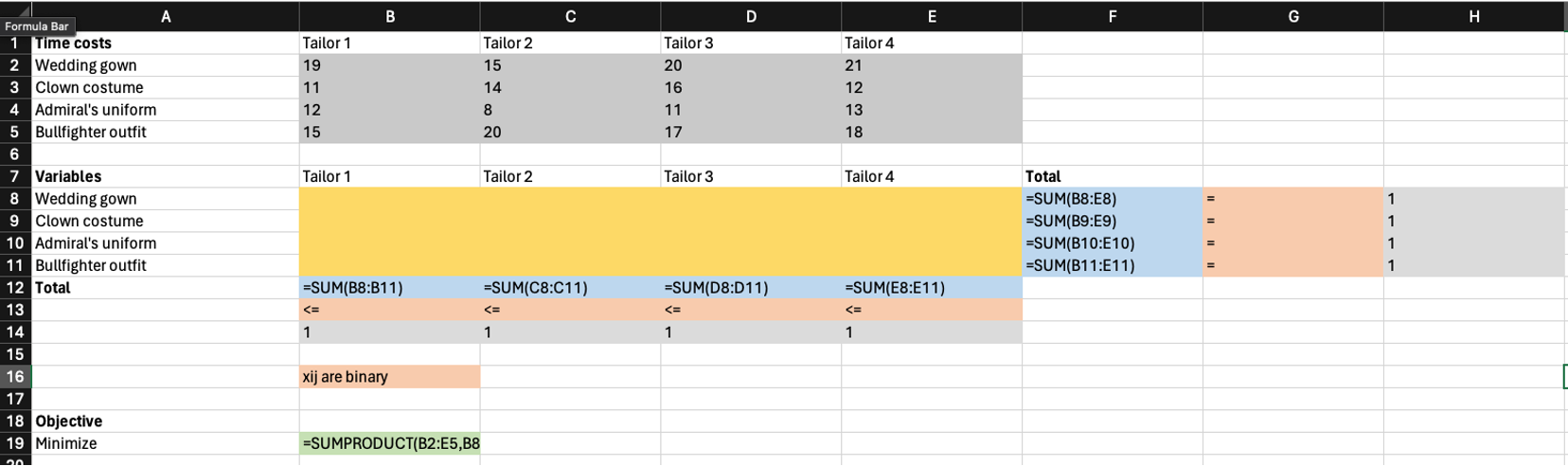
Excel Solver Setup
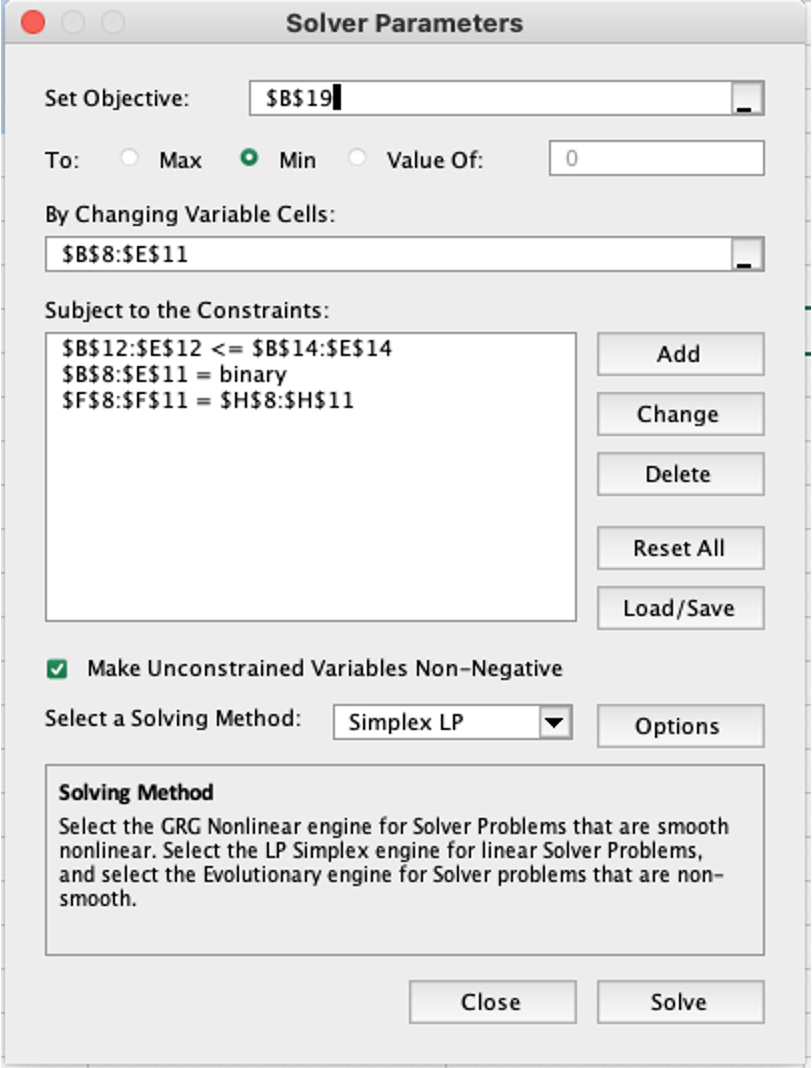
Solved Excel Model
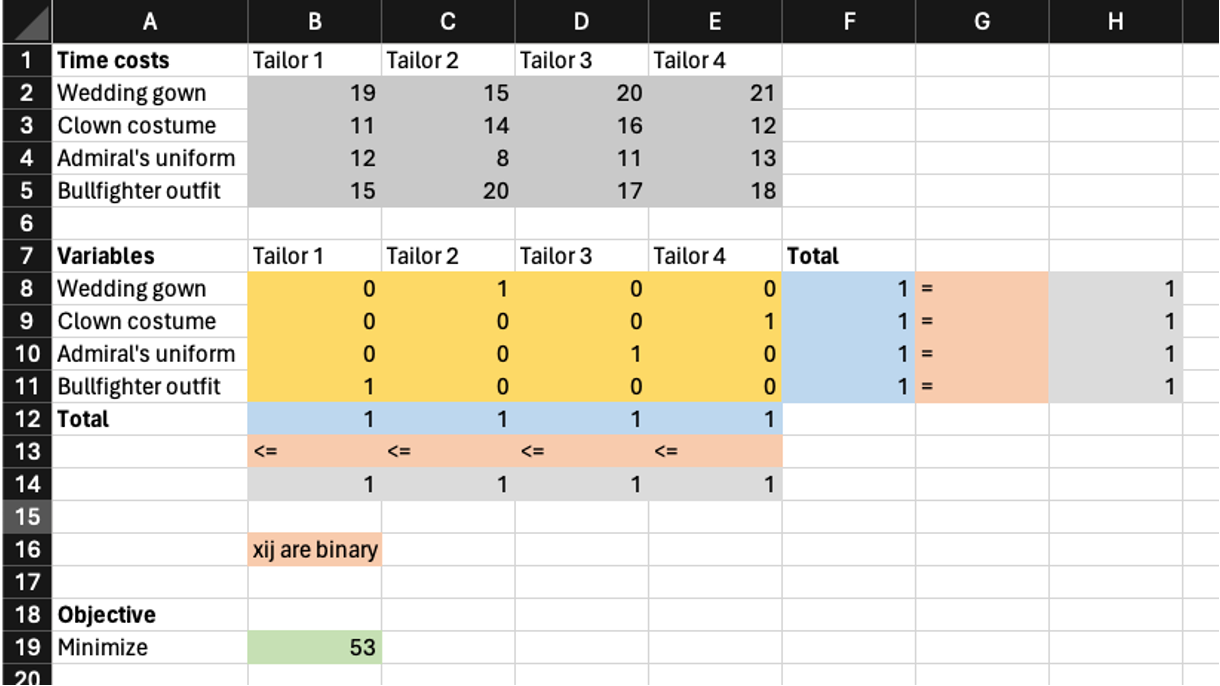
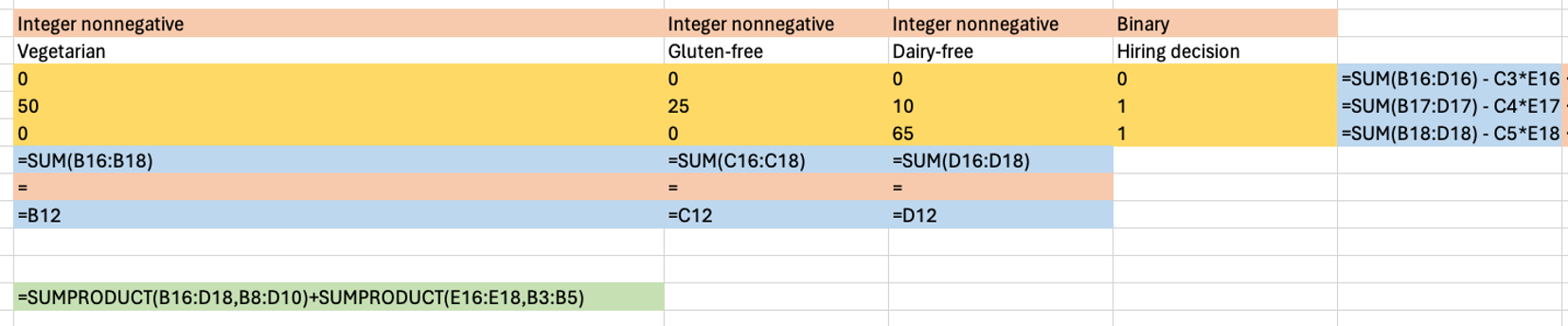
Spreadsheet setup
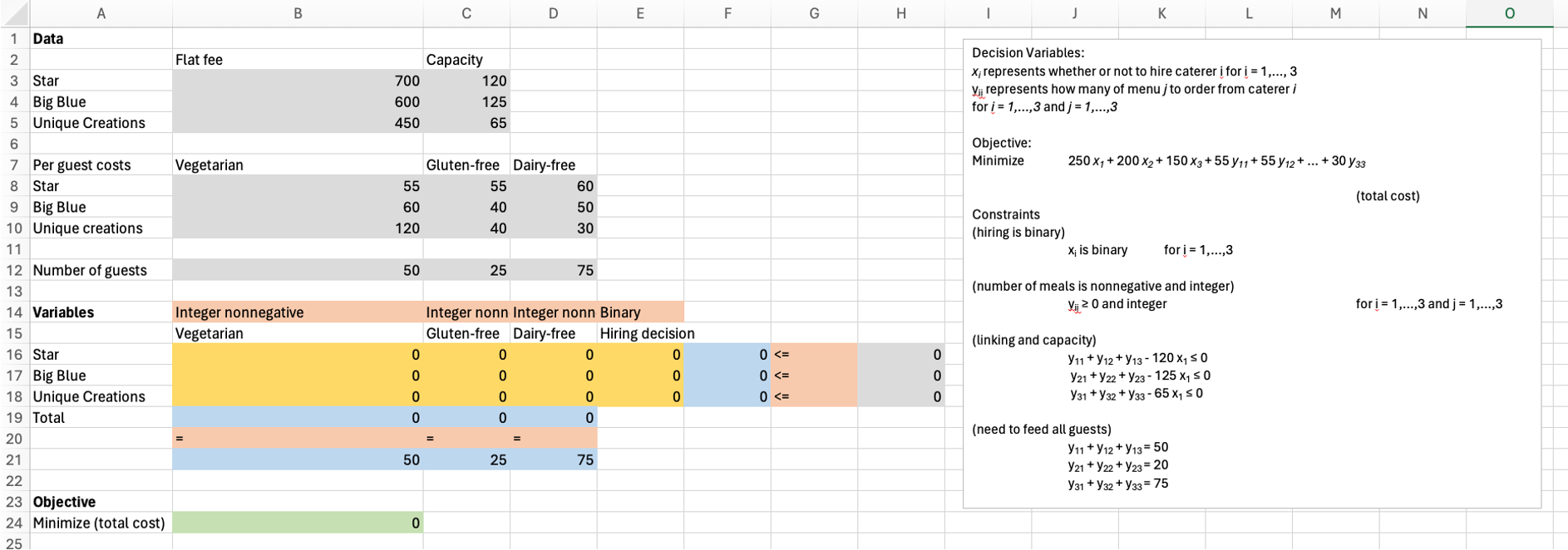
Spreadsheet formulas
Spreadsheet Solver Settings
Spreadsheet Completed