Additional Integer Programming Applications

MGMT 306

Alex L. Wang

Purdue University

Fixed-Cost Transportation

Transportation Problems

  • A very common problem
  • Goods are produced in plants or stored in warehouses across the US
  • How to route to consumers efficiently?
  • Many interesting management/analytics questions:
    • If we can open only a few warehouses, which to open?
    • If we want to minimize carbon emissions, what mix of shipment options should we offer?
    • If different courriers “own” different routes, which couriers should we contract?
    • Etc.

GlassWorks

Transportation problem

Problem Description

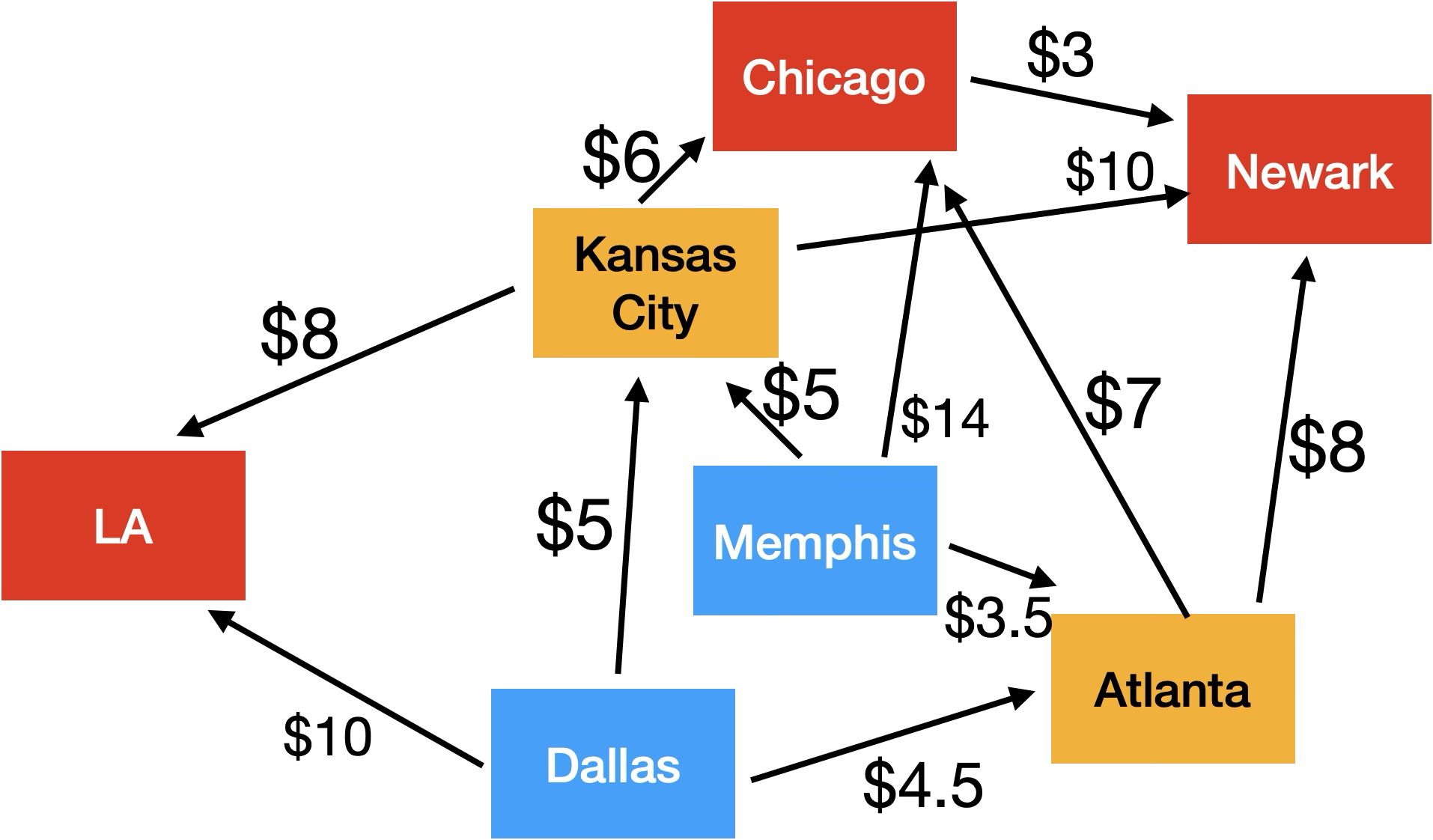
  • GlassWorks produces glass vases in Memphis and Dallas workshops
  • Each workshop has a weekly production capacity of 250 vases
  • This week, GlassWorks must ship 120 vases to Los Angeles, 140 vases to Newark, and 150 vases to Chicago
  • Intermediate warehouses in Atlanta and Kansas City may be used for trans-shipment
  • Unit shipping costs are indicated

Transport network for the Glassworks problem with unit shipping costs labeled.

ILP Model

  • Variables \[\begin{aligned} x_{MA} \qquad&\text{number of vases to ship Memphis to Atlanta}\\ x_{MK} \qquad&\text{number of vases to ship Memphis to Kansas City}\\ x_{MC} \qquad&\text{number of vases to ship Memphis to Chicago}\\ \dots\qquad& (\text{12 total variables}) \end{aligned}\]

  • Objective \[\min\qquad 3.5 x_{MA} + 5 x_{MK} + 14 x_{MC} + \dots 3 x_{CN}\qquad\text{(total shipping costs)}\]

ILP Model Constraints

  • Flow at workshops \[\begin{aligned} &x_{MA} + x_{MK}+ x_{MC} \leq 250&&\text{(production capacity Memphis)}\\ &x_{DK} + x_{DA}+ x_{DL} \leq 250&&\text{(production capacity Dallas)} \end{aligned}\]

  • Flow at warehouses \[\begin{aligned} &x_{MA} + x_{DA} - x_{AC} - x_{AN} =0&&\text{(net flow Atlanta)}\\ &x_{MK} + x_{DK} - x_{KC} - x_{KL} - x_{KN} = 0&&\text{(net flow KC)} \end{aligned}\]

  • Flow at customers \[\begin{aligned} &x_{KL} + x_{DL} = 120 &&\text{(demand LA)}\\ &x_{KN} + x_{AN} + x_{CN} = 140&&\text{(demand Newark)}\\ &x_{MC} + x_{KC} + x_{AC} - x_{CN} = 150&&\text{(demand Chicago)} \end{aligned}\]

ILP Model Constraints Continued

  • Nonnegativity and integrality \[x_{MA}, x_{MK},\dots,x_{CN}\geq 0 \text{ and integer}\]

Spreadsheet Model

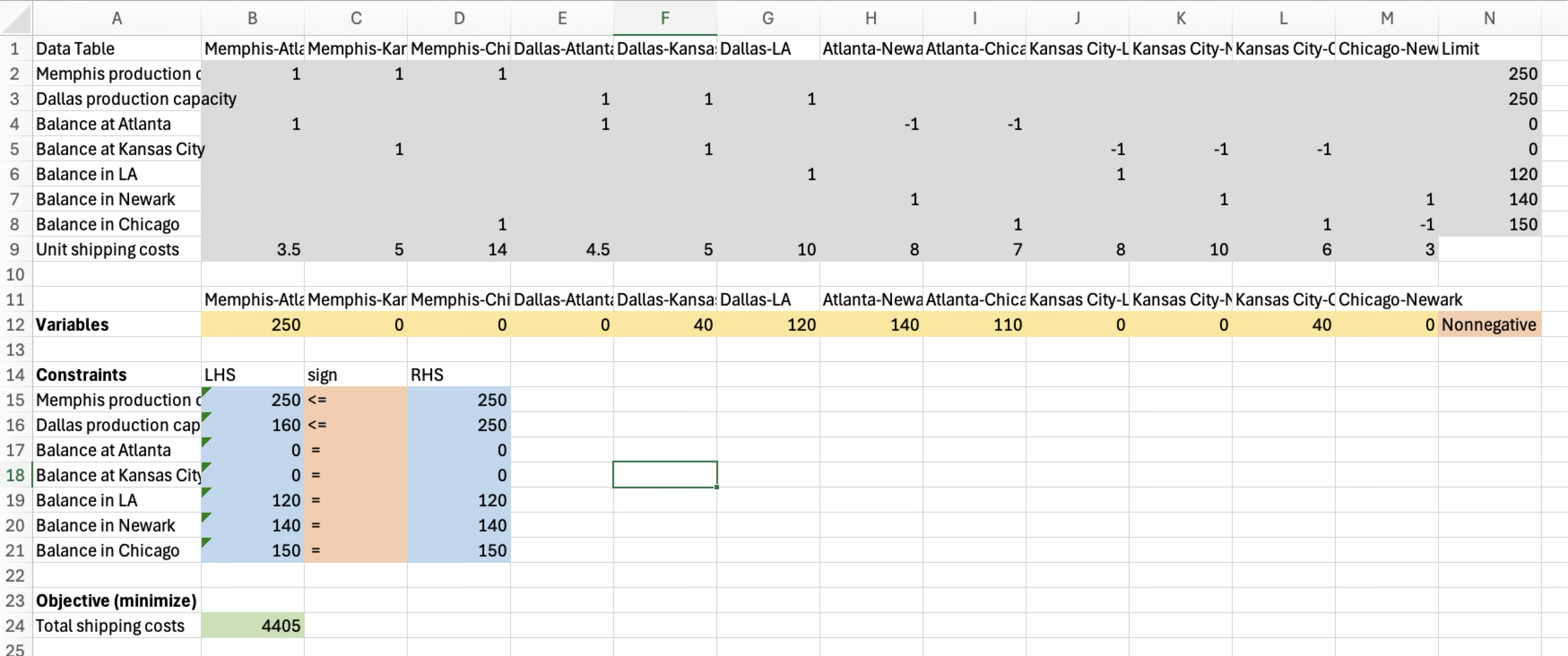
Spreadsheet formulation of the GlassWorks problem. In this version, the variables are arranged horizontally in a single row.

Spreadsheet Model Alternate

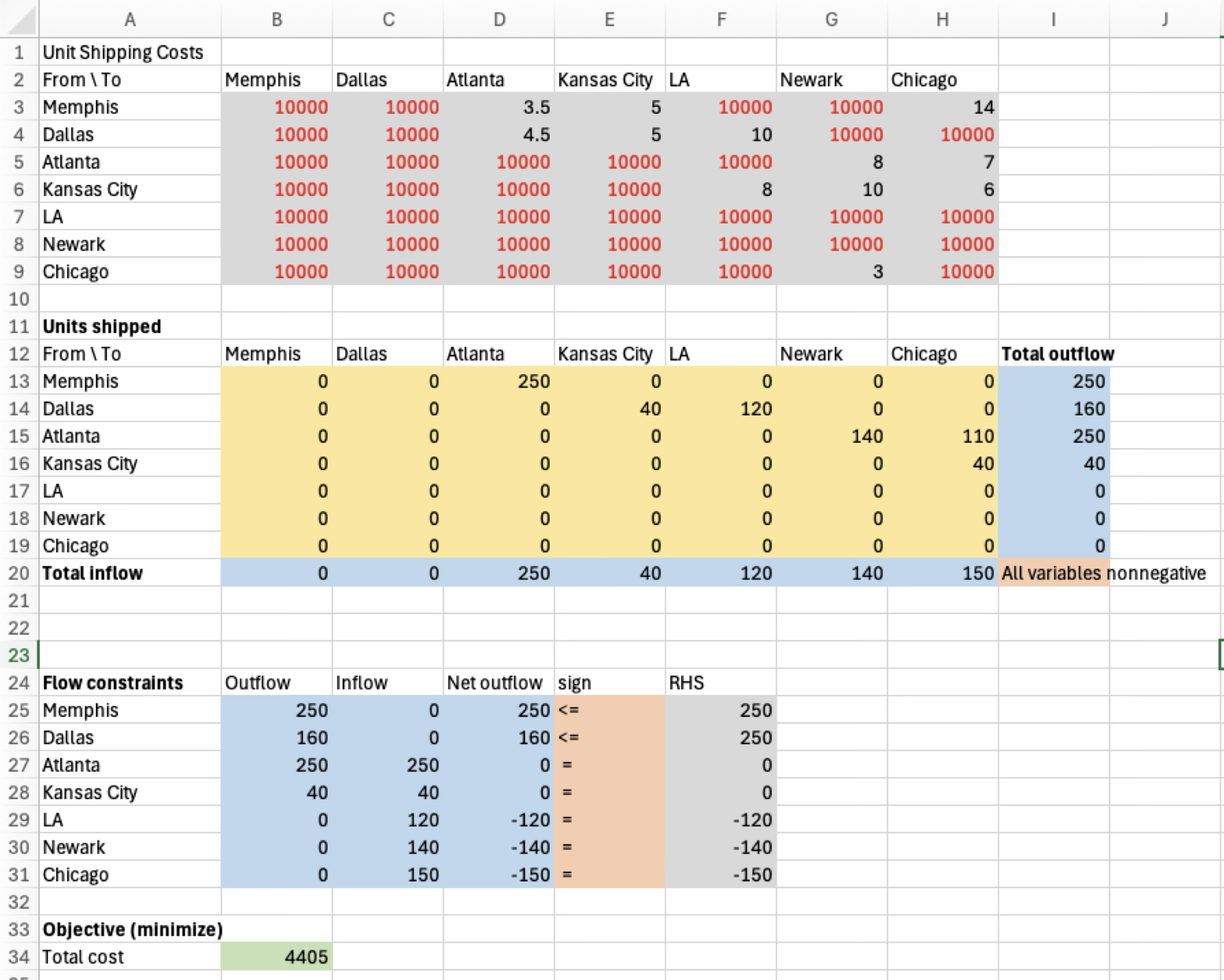
Alternate spreadsheet formulation of the GlassWorks problem. In this version, the variables are arranged as a 2-dimensional array.

Optimal Solution

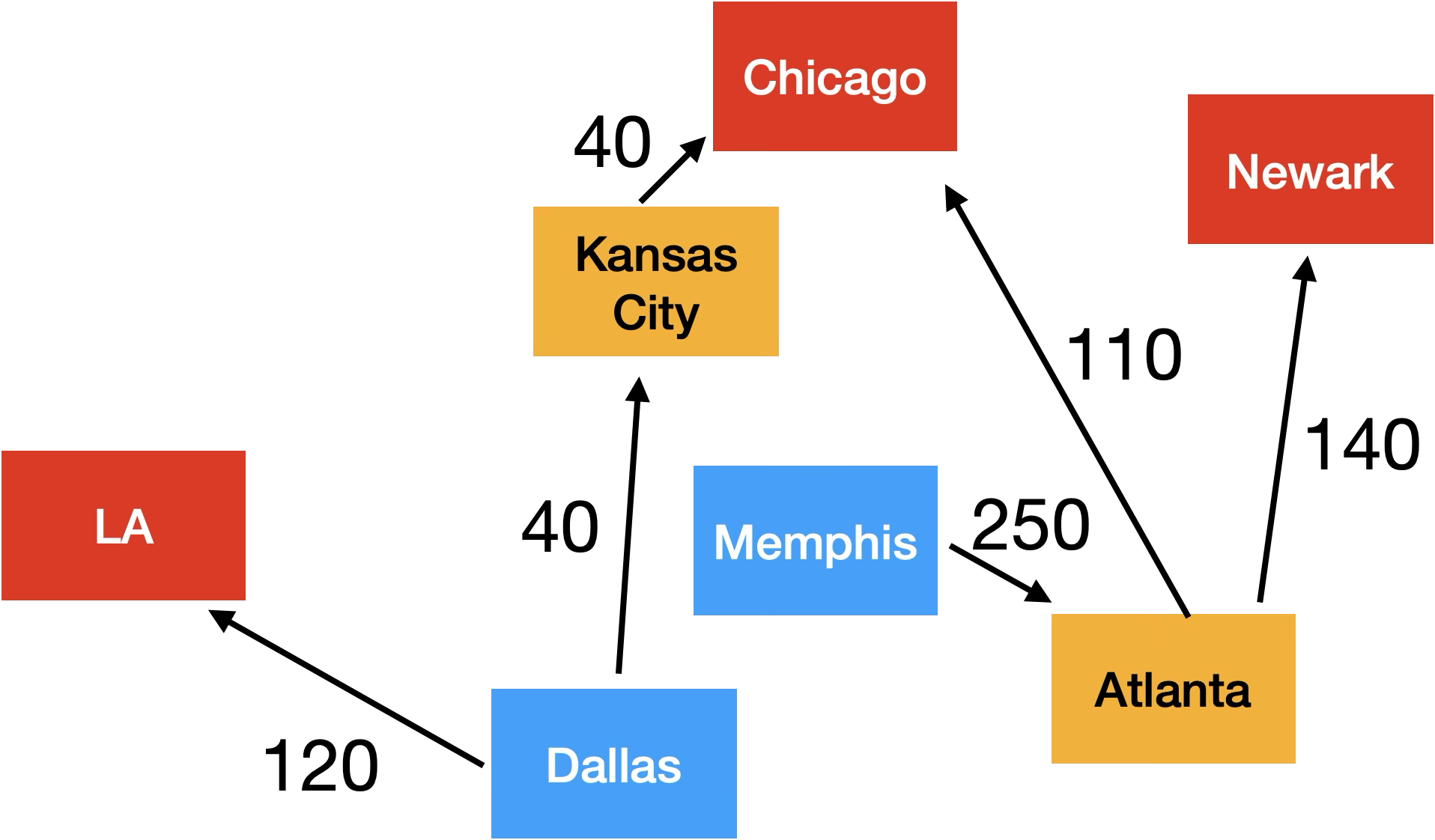
Optimal solution in the GlassWorks problem.

Transportation with Fixed Costs or Minimums

Problem Description

  • GlassWorks decides that this LP model is not realistic enough
  • They want to incorporate the following additional stipulations:
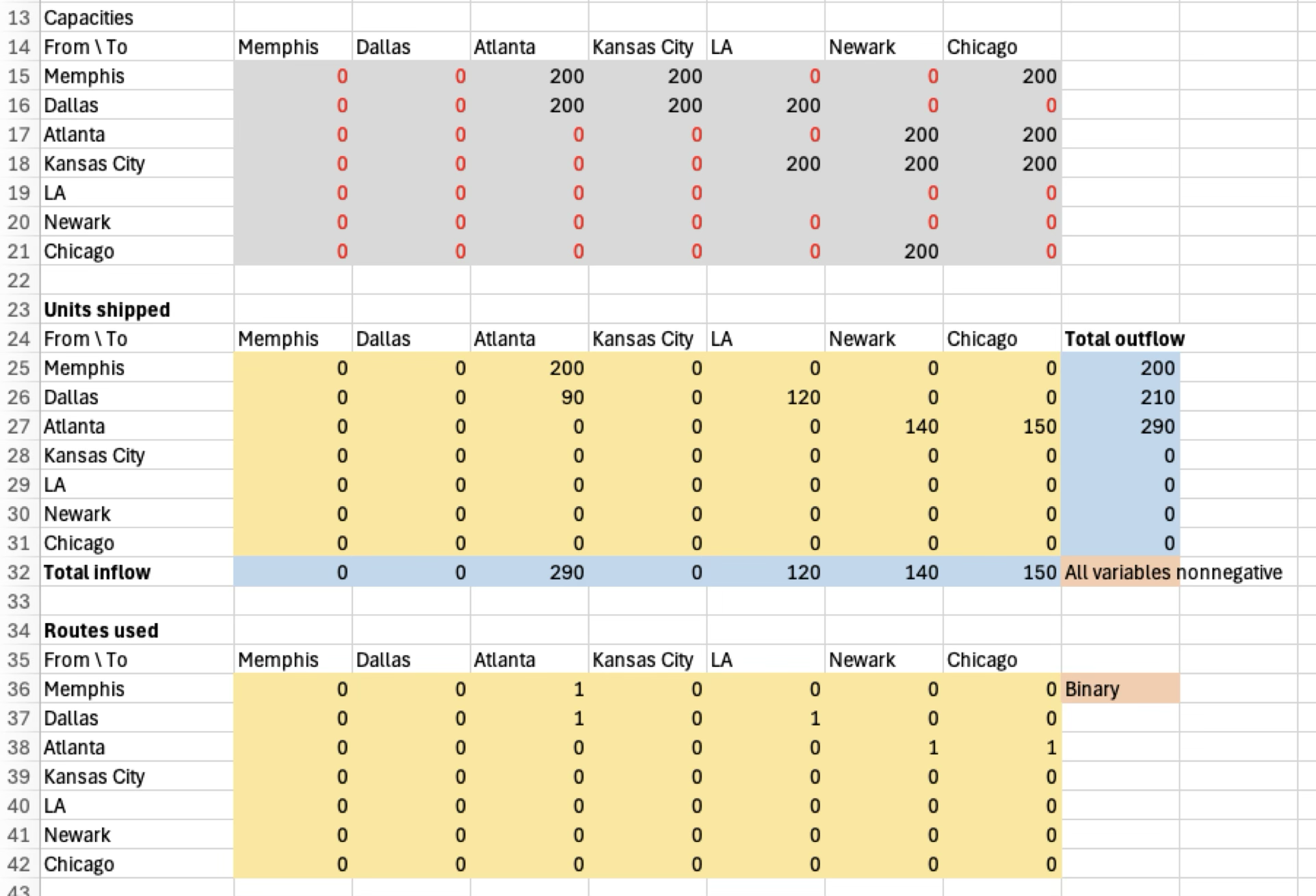
    • Each route can transport at most 200 vases
    • The cost of shipping vases along any route consists of a fixed cost ($200) plus the variable costs (as before). This fixed cost must be paid if GlassWorks ships any number of vases along that route
    • Think: Linking constraints

ILP Model

  • Variables \[\begin{aligned} x_{MA} \qquad&\text{number of vases to ship Memphis to Atlanta}\\ x_{MK} \qquad&\text{number of vases to ship Memphis to Kansas City}\\ x_{MC} \qquad&\text{number of vases to ship Memphis to Chicago}\\ \dots\qquad& (\text{12 total $x_{i,j}$ variables})\\ y_{MA} \qquad&\text{whether to ship from Memphis to Atlanta}\\ y_{MK} \qquad&\text{whether to ship from Memphis to Kansas City}\\ y_{MC} \qquad&\text{whether to ship from Memphis to Chicago}\\ \dots\qquad& (\text{12 total $y_{i,j}$ variables})\\ \end{aligned}\]

  • Objective \[\begin{aligned} \min\qquad &3.5 x_{MA} + 5 x_{MK} + 14 x_{MC} + \dots + 3 x_{CN}\\ & + 200 y_{MA} + 200 y_{MK} + 200 y_{MC} + \dots + 200 y_{CN}\qquad\text{(total costs)} \end{aligned}\]

ILP Constraints

  • Constraints from before
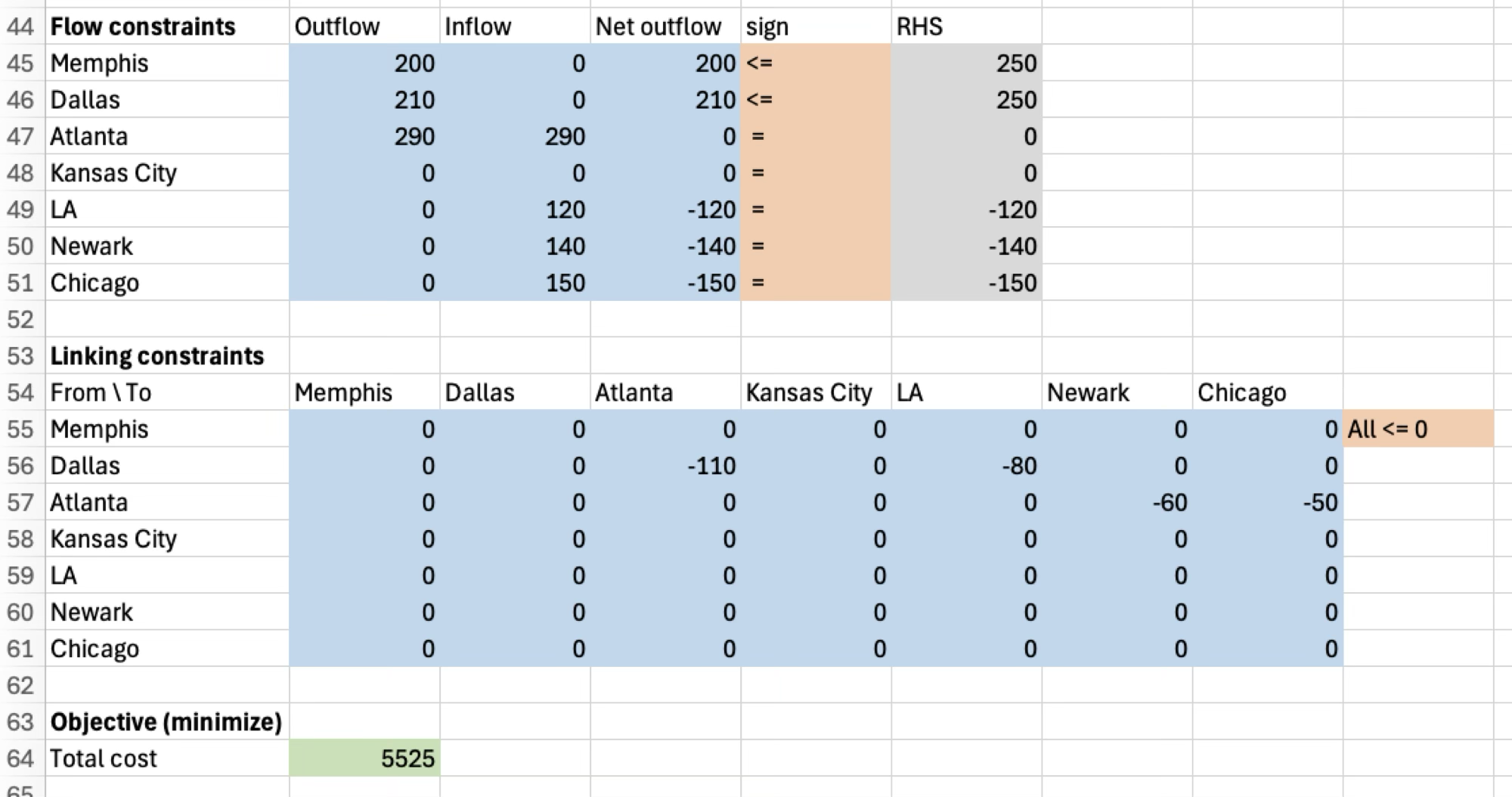
  • Capacity and linking constraints \[x_{i,j} \leq 200 y_{i,j} \qquad\text{for every arc $(i,j)$}\]
  • Binary decisions \[y_{i,j}\text{ binary for every arc $(i,j)$}\]

Spreadsheet Model

Top half of spreadsheet implementation of the GlassWorks problem with fixed costs.

Spreadsheet Model Continued

Bottom half of spreadsheet implementation of the GlassWorks problem with fixed costs.

Optimal solution

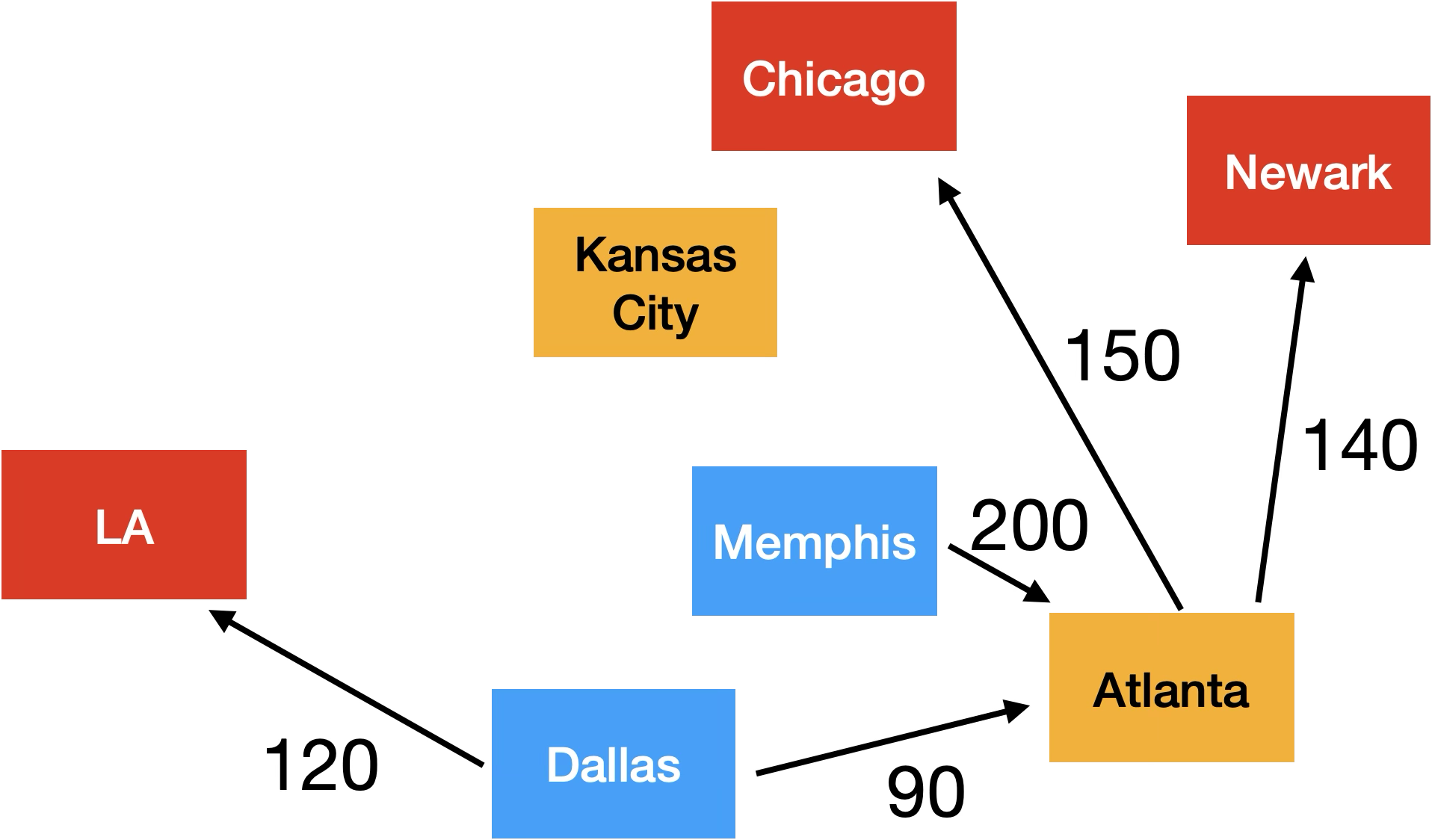
New solution to the GlassWorks problem.

Fixed costs incentivize using fewer edges. The previous shipments from (Dallas-Kansas City-Chicago) are now rerouted (Dallas-Atlanta-Chicago) to reuse the Atlanta-Chicago route.

Other practical variants of this problem

  • Multiple(non-interchangeable) goods - USPS must route mail to their recipients, but different pieces of mail still contribute to the same capacity constraints
  • Fixed costs on warehouses - Logistics company needs to decide where to open a new warehouse
    • Add binary variables on warehouses and linking constraints
  • Fixed costs on sets of routes - A major airline wants to expand its network and may sign contracts with competing regional airlines
    • Add binary variables per regional airline and group linking constraints