Multicriteria Decision Making
MGMT 306
Purdue University
Pareto Efficiency
Multiple criteria
- In the previous chapters we focused on making decisions by optimizing a single objective
- In reality, there may be many relevant but conflicting objectives
- Two approaches:
- Combine all the objectives into a single objective
- Deal with multiple objectives. We need to redefine what it means for a solution to be “optimal”
- In multi-objective problems, we will discuss “efficient” solutions
Example: Comparing Job Offers
- Suppose we are looking for a new job and have received three offers: A, B, and C. We would like to pick the job with the shortest commute possible, highest salary, and highest expected job satisfaction
| Job | Commute time (in minutes) | Salary ($K) | Expected job satisfaction |
|---|---|---|---|
| Job A | 15 | 75 | 8.5 |
| Job B | 75 | 80 | 7.0 |
| Job C | 20 | 85 | 7.5 |
- We prefer a shorter commute, higher salary, and higher job satisfaction
- What can we say?
Efficient solutions
- Alternative A dominates alternative B if
- A is at least as good as B with respect to every objective and
- A is strictly better than B with respect to at least one objective
- Alternative A is not efficient if it is dominated by some other alternative
- An alternative is efficient if it is not dominated by any other alternative
- Also called Pareto efficient or Pareto optimal
Example: Comparing Job Offers Efficient Solutions
- Suppose we are looking for a new job and have received three offers: A, B, and C. We would like to pick the job with the shortest commute possible, highest salary, and highest expected job satisfaction
| Job | Commute time (in minutes) | Salary ($K) | Expected job satisfaction |
|---|---|---|---|
| Job A | 15 | 75 | 8.5 |
| Job B | 75 | 80 | 7.0 |
| Job C | 20 | 85 | 7.5 |
- We prefer a shorter commute, higher salary, and higher job satisfaction
- What can we say?
- Job C dominates Job B so Job B is not efficient
- Job A and Job C are both efficient
Determining Efficient Solutions Graphically
- If there are only two metrics (objectives) then we can plot the alternatives
| Ad campaign | Cost ($K) | Estimated reach (K persons) |
|---|---|---|
| A | 15 | 20 |
| B | 20 | 30 |
| C | 20 | 40 |
| D | 18 | 15 |
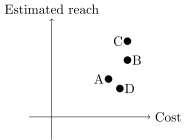
- We prefer lower cost and higher estimated reach
- One alternative dominates another if it is northwest of the other point
- Which alternatives are efficient?
Determining Efficient Solutions Graphically (continued)
- Alternative A: is efficient
- Alternative B: is not efficient. It is dominated by Alternative C
- Alternative C: is efficient
- Alternative D: is not efficient. It is dominated by alternative A
Efficient Investment Example
Setup
- A client has $ 80,000 to invest into some combination of three stocks
- The client wants to maximize their annual return and also to avoid high risk
| Stock | Price/share | Est. annual return/share | Risk index/share |
|---|---|---|---|
| A | $25 | $3 | 0.5 |
| B | $50 | $5 | 0.25 |
| C | $40 | $4 | 0.3 |
Setup (cont.)
- Portfolio alternatives:
- Invest all $80,000 into stock A
- Invest all $80,000 into stock B
- Invest $20,000 into stock A and $60,000 into stock B
- Invest $80,000 into stock C
- Compute the estimated annual return and risk index for each portfolio
- Which of these solutions are Pareto efficient?
Solution
| Portfolio | Est. annual return | Risk index |
|---|---|---|
| 1 | $9,600 | 1,600 |
| 2 | $8,000 | 400 |
| 3 | $8,400 | 700 |
| 4 | $8,000 | 600 |
- Portfolios 1, 2, 3 are Pareto Efficient
- Portfolio 4 is not pareto efficient: dominated by portfolio 2
Working with ordinal data instead of cardinal data
- Cardinal data:
- A measurement of how good each alternative is on each metric
- Ordinal data:
- The ordering for each alternative on each metric
For example:
| Portfolio | Est. annual return | Risk index |
|---|---|---|
| 1 | Best | Worst |
| 2 | Third best (tied) | Best |
| 3 | Second best | Third best |
| 4 | Third best (tied) | Second best |
See homework
Goal Programming
Overview
- In some scenarios, there may be multiple “goals” that we would like to hit
- You can think of these as somewhere in between a constraint and an objective function
- “Ensure a profit of at least $3,000 if possible. Otherwise, maximize profit.”
Example with one goal
- Organic Greenhouses:
- 12 acres land to plant peppers or tomatoes
- Peppers require 1.5 hours of labor/acre and tomatoes require 3 hours of labor/acre
- 30 hours of labor available
- At most 6 of the acres of land can be used for peppers
- Profit per acre is $30,000 for peppers and $40,000 for tomatoes
- Goal 1:
- Profit at least $350,000
LP Setup
Set up LP as usual but no objective for now
Variables: \[\begin{aligned} &P\quad\text{acres of peppers to plant}\\ &T\quad\text{acres of tomatoes to plant}\\ \end{aligned}\]
Constraints \[\begin{aligned} & P + T \leq 12 &&\text{(total acreage)}\\ & 1.5 P + 3T \leq 30 && \text{(labor)}\\ & P \leq 6 && \text{(pepper acreage)}\\ & P, T \geq 0 && \text{(nonnegativity)} \end{aligned}\]
Excel setup
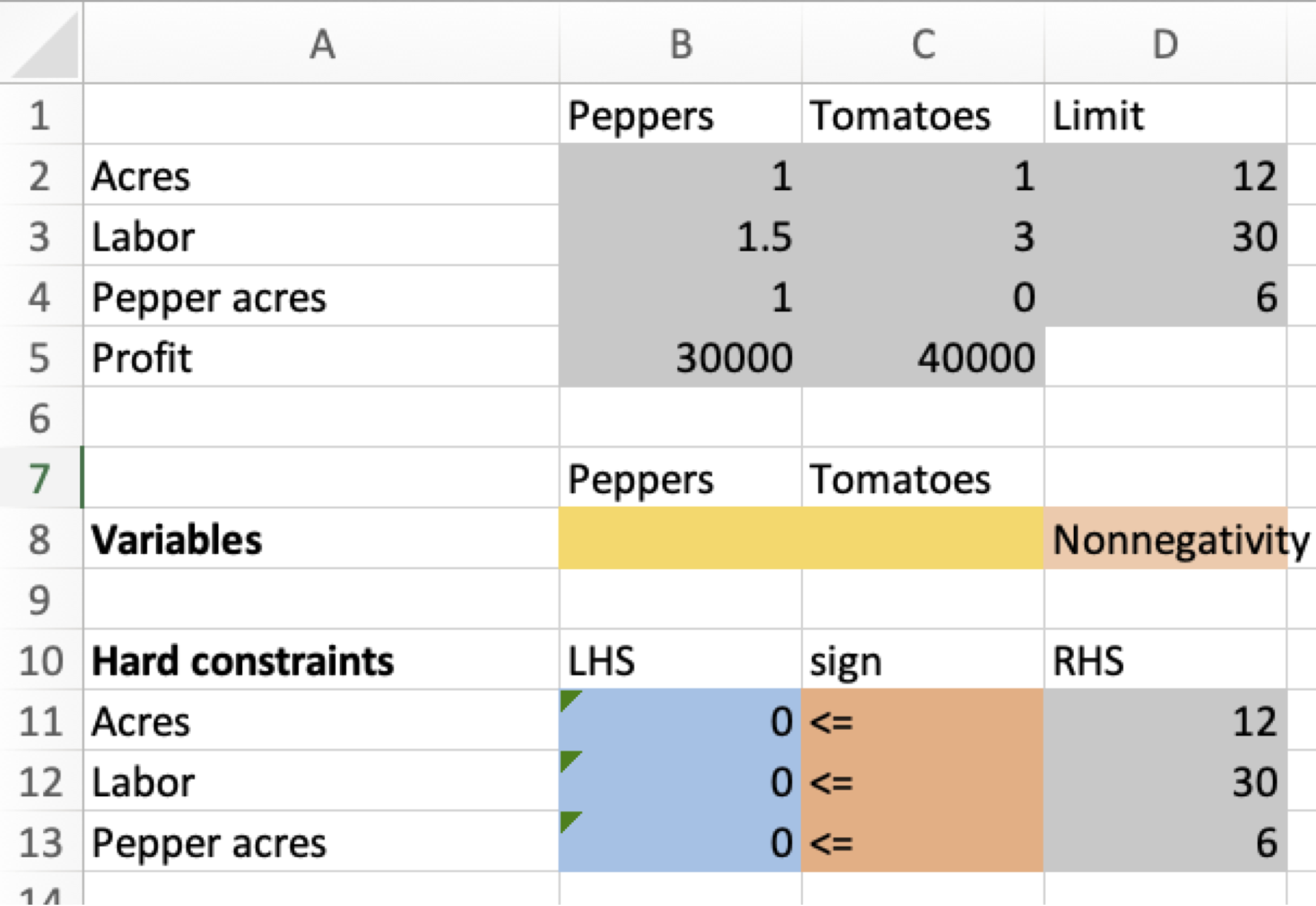
LP Setup for Goal 1
Introduce two new variables for Goal 1: \[\begin{aligned} & d_1^- &&\text{amount by which Goal 1 is underachieved}\\ & d_1^+ &&\text{amount by which Goal 1 is overachieved} \end{aligned}\]
Add constraints: \[\begin{aligned} & 30,000 P + 40,000 T +d_1^- - d_1^+ = 350,000 &&\text{(balance)}\\ &d_1^- , d_1^+ \geq 0&&\text{(nonnegativity)} \end{aligned}\]
Objective: \[\min \qquad d_1^-\qquad\text{(underachievement)}\]
Excel setup with Goal 1
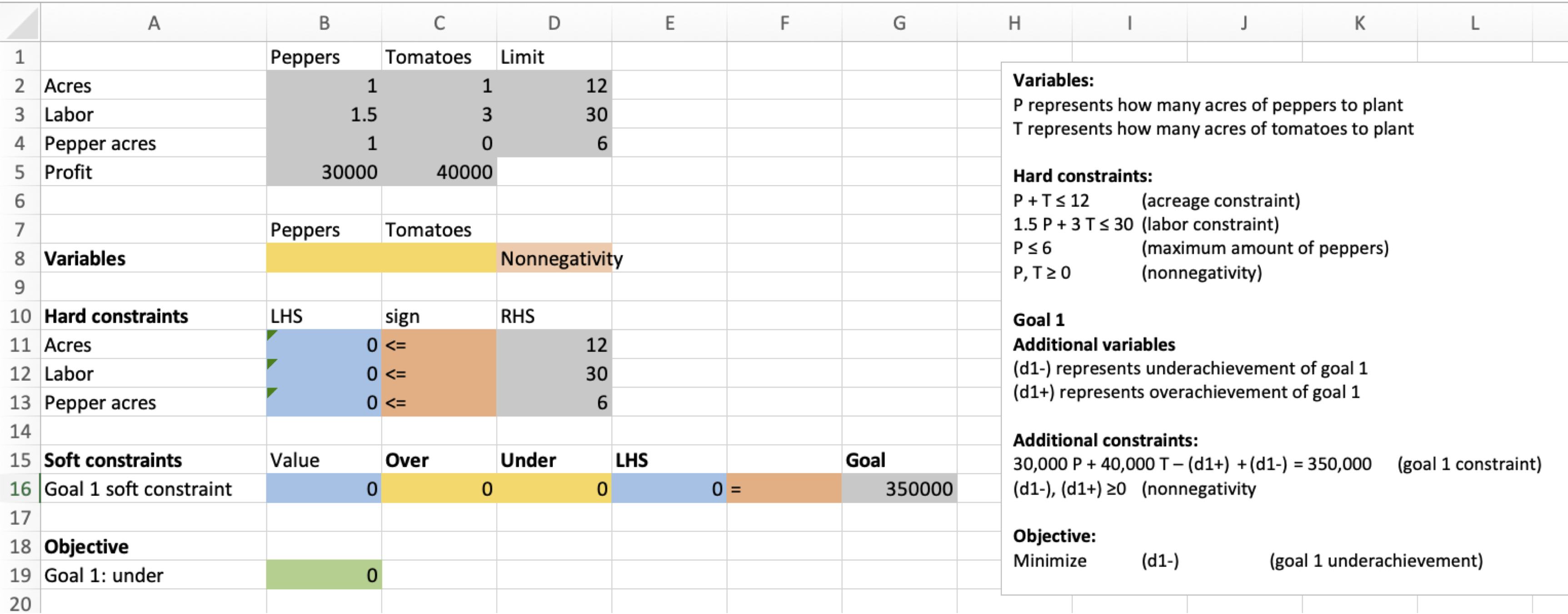
Excel setup with Goal 1 (formulas)
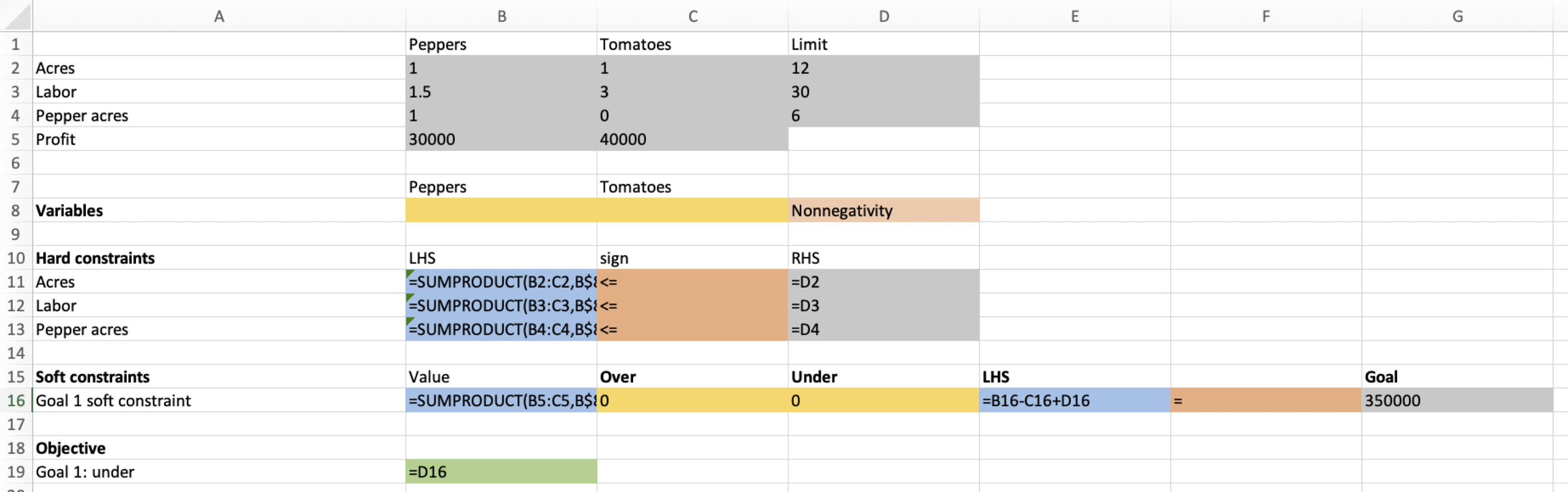
Excel setup with Goal 1 Solved
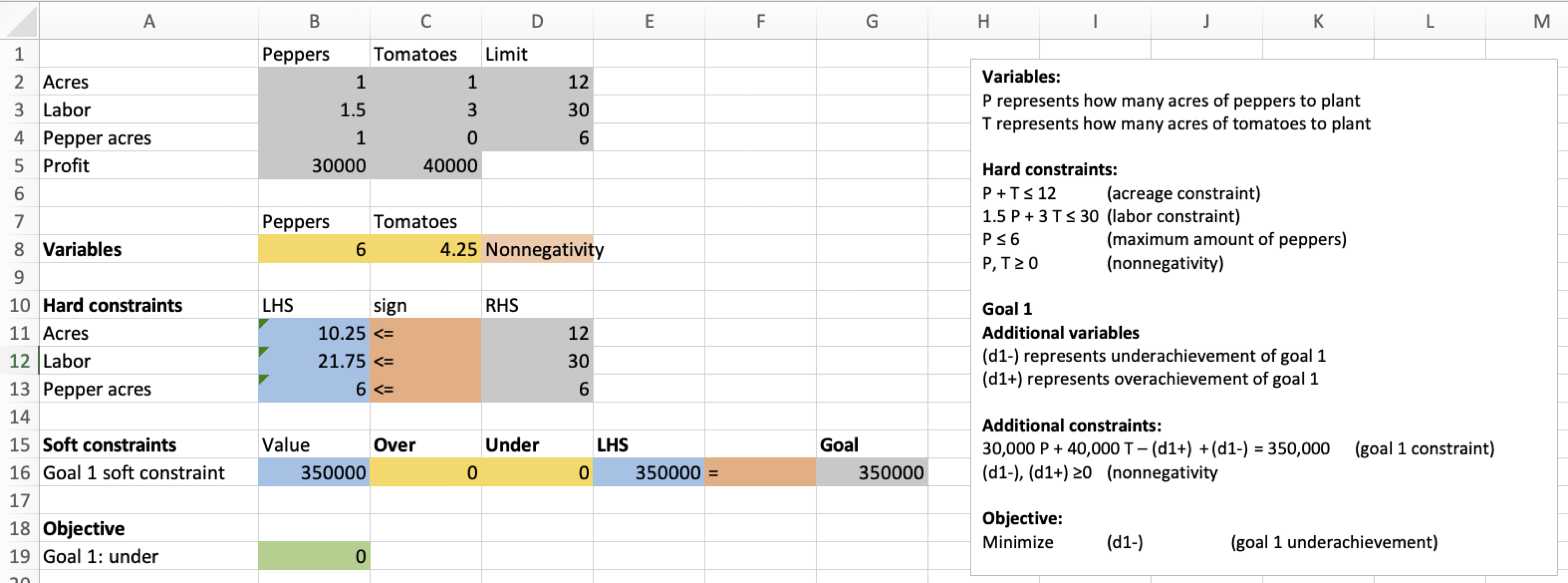
We learn that it is possible to achieve Goal 1 (the underachievement is 0)
Dealing with multiple goals
- If we have multiple goals, we will prioritize them and try to hit the goals one at a time – preemptive priorities
- We will do as well as we can on Goal 1
- Then, we will do as well as we can on Goal 2 without sacrificing how well we did on Goal 1
- Etc.
LP Modifications for multiple goals
- For each Goal \(i\), introduce two new variables \[\begin{aligned} & d_i^- &&\text{amount by which Goal $i$ is underachieved}\\ & d_i^+ &&\text{amount by which Goal $i$ is overachieved} \end{aligned}\]
- There are three types of goals we can model
- At least some value \(\quad\min d_i^-\)
- At most some value \(\quad\min d_i^+\)
- Exactly some value \(\quad\min (d_i^- + d_i^+)\)
Organic Greenhouses with additional goals
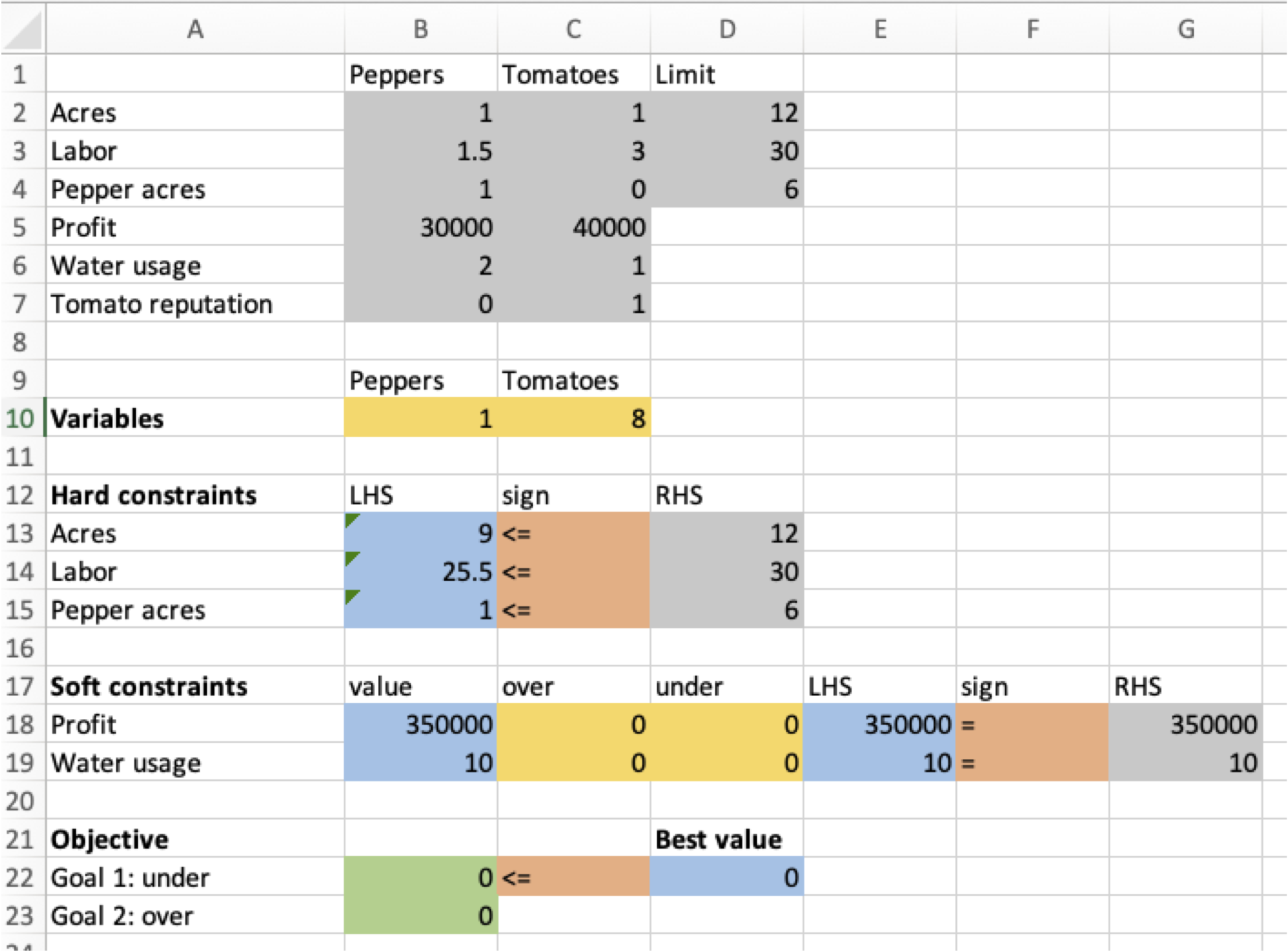
- Goal 2: Use at most 10 acre-inches of water per week
- Peppers require 2 acre-inch of water per acre per week whereas tomatoes require 1 acre-inches of water per acre per week
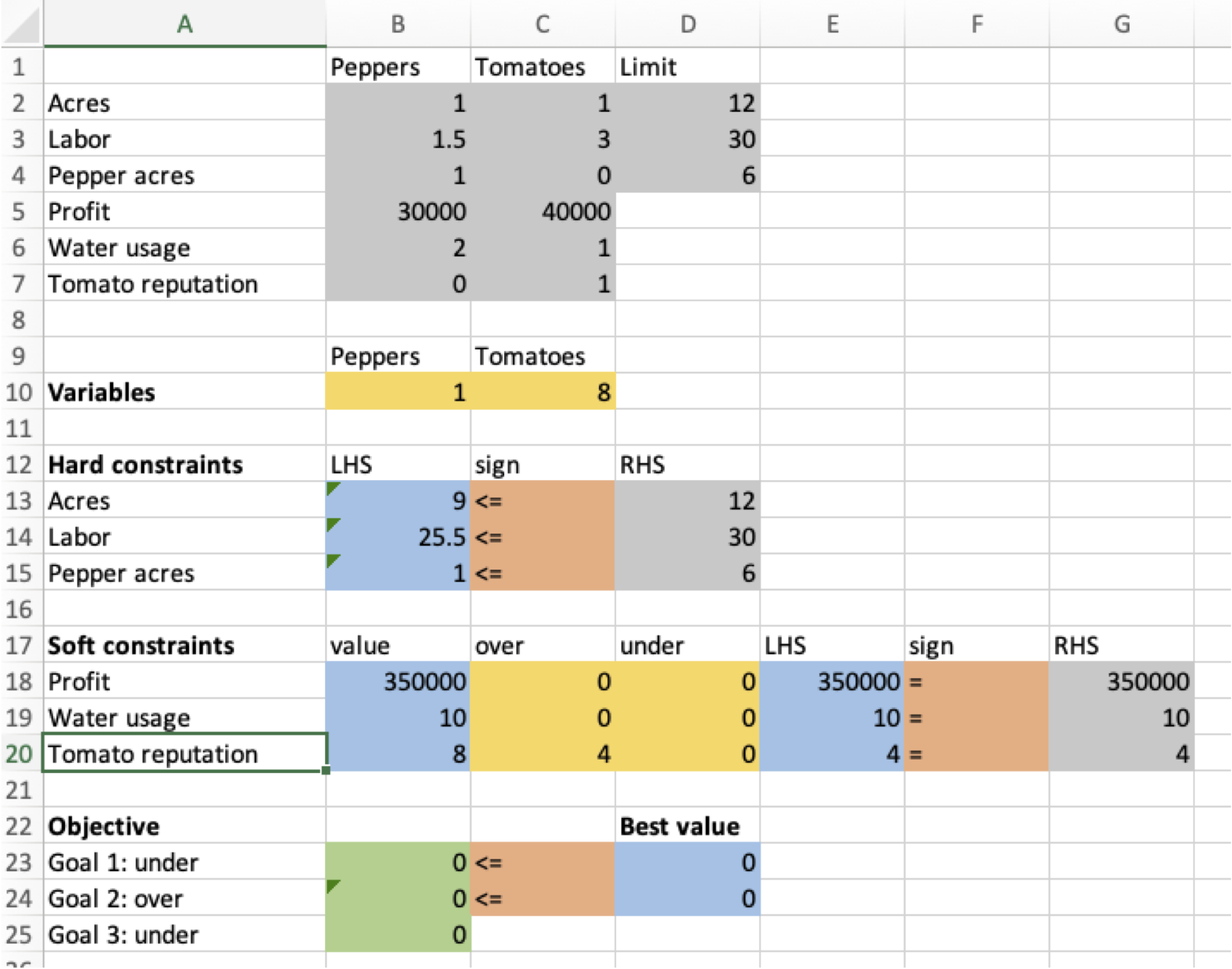
- Goal 3: Plant at least 4 acres of tomatoes
- Organic Farms wants to uphold their reputation as tier-1 tomato producers.
Steps:
- Minimize underachievement of Goal 1 and set that as a constraint
- Minimize overachievement of Goal 2 and set as a constraint
- Minimize underachievement of Goal 3
Excel with completed 2nd goal
Excel with completed 3rd goal
Goal Programming Practice
Setup
- New England Cycle Company is planning production
- They produce Tandem bikes and Single-Rider bikes
- Tandem bikes require 2 seats, 2 tires, 2 hours of labour
- Single-Rider bikes require 1 seat, 2 tires, 3 hours of labour, and 1 gear assembly
- New England Cycle Company has 2000 seats, 2400 tires, 1000 gear assemblies
- Each tandem bike and single-rider bike yields $40 in profit and $100 in profit respectively
Goals
Managment has the following goals:
- Goal 1: Fulfill a contract of 400 tandem bikes it has already promised to deliver
- Goal 2: Produce at least 1000 bicycles total
- Goal 3: Achieve at least $100,000 profit
- Goal 4: Use no more than 1600 labor hours